
You may encounter a revocable living trust while reviewing an estate plan, buying property, planning for incapacity, or preparing to sell a business. The practical question is simple: what does the trust actually do, and when might it be useful? This guide explains the basics in plain English. It is general education, not legal or tax advice.
What a Revocable Living Trust Actually Is
A revocable living trust is a legal arrangement you create while you are alive that holds title to assets you transfer into it.
Two words carry the meaning. Revocable means you can amend it, add to it, pull assets out, or cancel it entirely for as long as you are alive and mentally competent. Living (attorneys sometimes say inter vivos) means it takes effect the day you sign, not the day you die.
Revocable trust means you can still access and remain owners of the assets during your life. So you can put your house into the trust in case …Read on Reddit ↗
A useful way to think about a revocable trust is as a legal container, not an investment. It can change how eligible assets are titled and managed, but it does not automatically keep every asset out of probate.
Its main purposes are to manage eligible assets during your lifetime, plan for incapacity, and direct the transfer of properly funded assets after death. A revocable trust is generally not a tax shelter.
One bit of vocabulary cleanup, because search results make this murkier than it is. “Revocable trust” and “living trust” usually describe the same document. A living trust can technically be revocable or irrevocable, but in everyday use, living trust means the revocable kind.
The Key Roles in a Revocable Living Trust
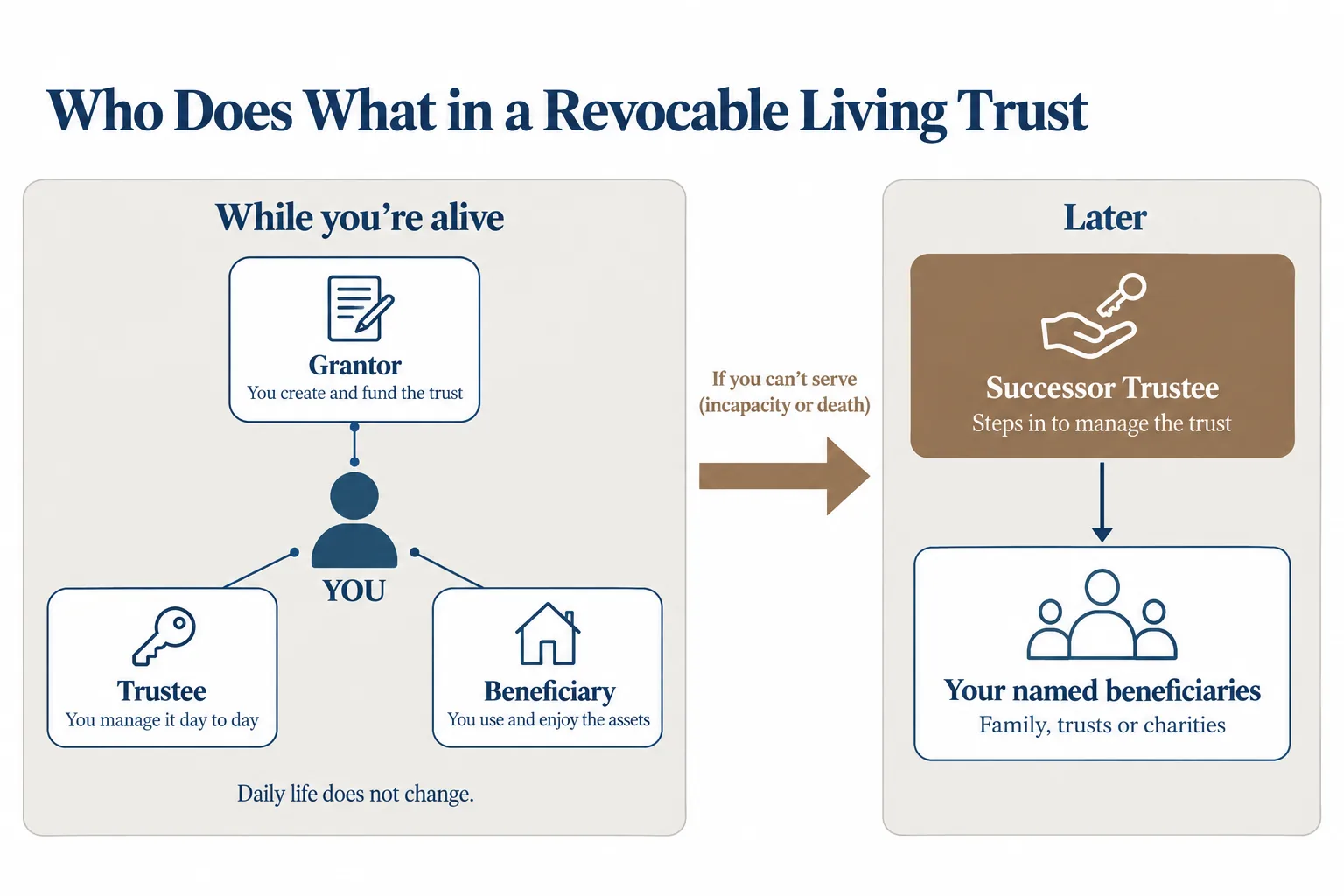
Confusion about trusts almost always comes from mixing up the roles.
Grantor (also called the settlor or trustor). The person who creates the trust and funds it. That is you.
Trustee. The person who manages property held in the trust. With a revocable living trust, you normally name yourself. You keep signing authority, you keep buying and selling, you keep filing your taxes the same way. Daily life does not change.
Successor trustee. The person or institution that steps in when you cannot serve, whether because of incapacity or death. A spouse, an adult child, a trusted friend, or a corporate trustee. This is the most consequential name in the document, and it deserves more thought than it usually gets.
Beneficiary. You, during your lifetime. Then the people, trusts, or charities you name afterward.
That answers a common question: who owns the property in a revocable trust? Technically, the trust holds title. Practically, you retain full control, full access, and full benefit, which is why the arrangement feels like nothing changed. One person routinely holds three of the four roles at once.
Because the grantor generally retains control, a revocable trust is often treated as a grantor trust for federal income-tax purposes, as described in the IRS Form 1041 instructions. Your CPA can confirm how your specific trust is reported.
How a Revocable Living Trust Works, Step by Step
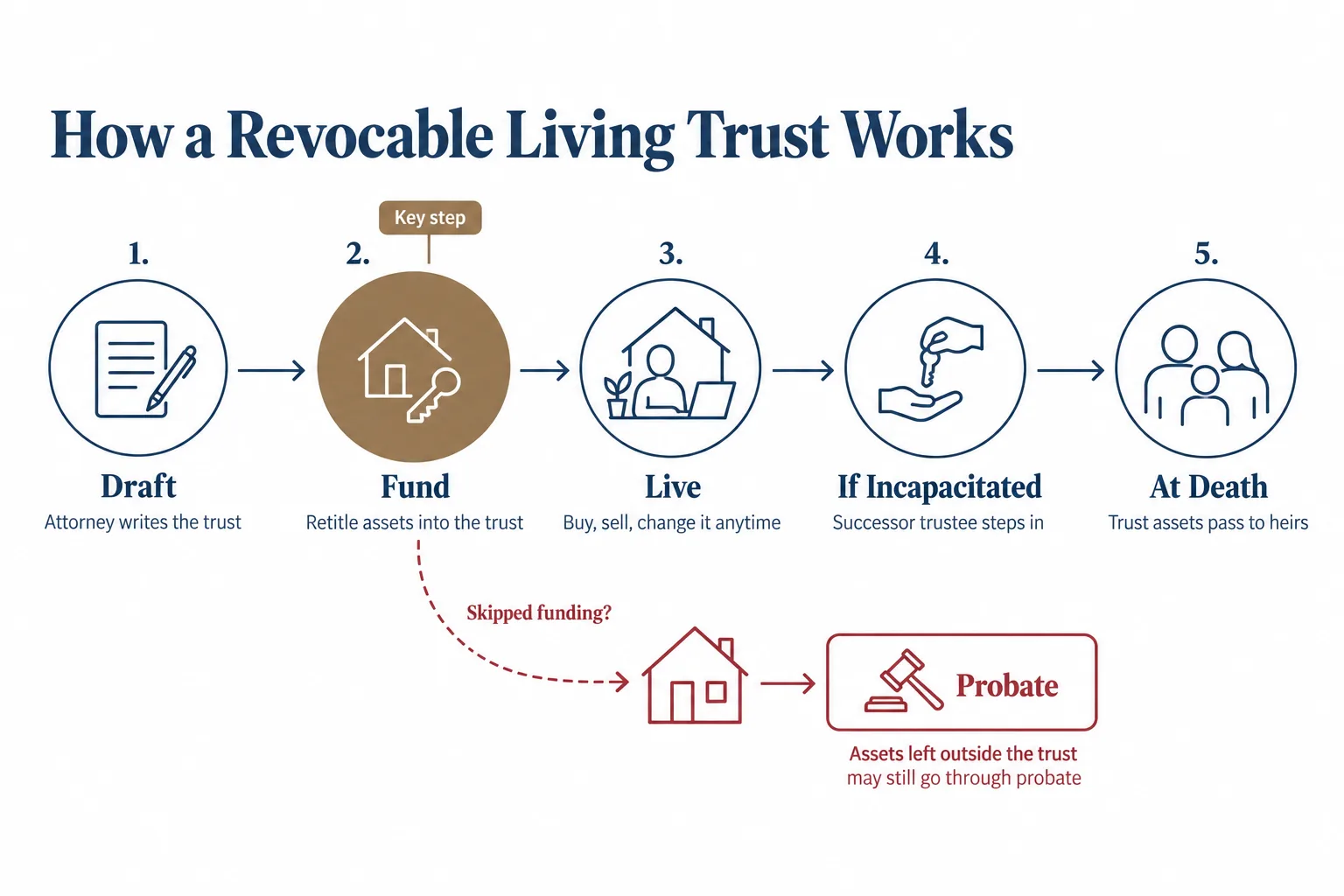
Draft it. An estate-planning attorney prepares the document, names the roles above, and spells out how assets are managed and eventually distributed.
Fund it. This is the step people skip, and skipping it makes the rest meaningless. Funding means retitling: new deeds for real estate, new registration on taxable brokerage and bank accounts, assignment of business interests where the operating agreement permits it.
Live normally. Buy, sell, refinance, spend, amend the terms when a child marries, or a partner exits the business.
If you become incapacitated. For assets properly held in the trust, your successor trustee may be able to manage them under the trust terms without a separate court appointment.
At death. The successor trustee administers properly titled trust assets under the trust terms; other assets may still require probate.
Funding is essential. If an asset is never transferred to the trust, the trust may not control it, and that asset may still pass through probate.
The Four Main Benefits
Probate avoidance. Depending on the state and the estate, keeping properly titled assets out of probate may reduce court involvement, delay, or administrative cost.
Continuity at incapacity. A funded trust can give a successor trustee authority to manage trust assets if you cannot act. A durable financial power of attorney may also be important for property outside the trust.
Privacy. Probate records are often public, while a funded trust may keep its terms out of the probate record; the result depends on state law and the trust documents.
Flexibility. You can rewrite or revoke it while you are competent. Nothing about it is a one-way door.
Property in another state may create a separate probate process there. Whether placing it in a trust helps depends on the state, the property, and how title is held, so consult an attorney licensed where the property is located.
The Limitations and Responsibilities
A revocable trust can be useful, but it also comes with responsibilities and limitations.
No automatic tax break. A revocable living trust generally does not reduce your income taxes, and the assets generally remain included in your taxable estate because you retain control.
No automatic asset protection. A revocable trust generally does not protect the grantor’s assets from the grantor’s own creditors or lawsuits. Asset-protection planning uses different tools and requires appropriate legal advice.
Cost and paperwork. A trust may cost more to establish than a simple will, and deeds and account changes require ongoing attention.
Ongoing discipline. New accounts, property, and entity interests must be reviewed and titled correctly; otherwise, they may remain outside the trust and pass through probate.
You still need a will. Many plans also use a pour-over will to address assets that were not transferred to the trust, although those assets may still pass through probate.
Which Assets Belong in a Revocable Living Trust?
Generally a good fit: taxable brokerage accounts, bank accounts, real estate, closely held business interests, and valuable personal property such as art or collections. The right treatment depends on the asset, the trust terms, and applicable law.
Retirement accounts are generally handled through beneficiary designations rather than retitled into a living trust during your lifetime. Naming a trust as the beneficiary of an IRA or retirement plan is a separate decision with tax and distribution consequences, so discuss it with your estate attorney and CPA.
HSAs, annuities, vehicles, life insurance, and S-corporation stock may require separate ownership or beneficiary analysis. Do not transfer or retitle these assets without confirming the consequences with the appropriate professional. Beneficiary designations and joint ownership can control how an asset passes, so they must be coordinated with the trust.
Should You Put Your House in a Revocable Living Trust?
Real estate is often one of the largest assets that might otherwise pass through probate, so the deed deserves close attention on the funding checklist.
Check a few things before recording a new deed. Property tax treatment, homestead-type protections, and title insurance coverage vary by state, so confirm the North Carolina specifics with local counsel. If the home carries a mortgage, ask your lender and your attorney how the transfer interacts with your loan documents before you sign. And tell your homeowner’s insurance carrier about the change in titling.
Revocable Living Trust vs. Will
A will generally takes effect at death for assets that pass under the will. It does not, by itself, manage your property during incapacity; a durable financial power of attorney may address part of that need.
A trust takes effect during life, may help with incapacity planning, and may keep its terms out of the probate record for assets properly funded into it; results vary by state and document.
This is not an either/or choice. A will is commonly used to nominate guardians for minor children, and a pour-over will may address an account you opened and forgot to retitle. Many plans use both documents together.
Living Trust vs. Living Will
A living trust manages property and explains how trust assets should be handled during your lifetime, incapacity, and after death. A living will generally addresses certain healthcare wishes. They are different documents, and neither one replaces a durable financial power of attorney when that document is appropriate.
Revocable vs. Irrevocable Trust: Control, Taxes, and Protection
The trade-off is control versus protection, and one document cannot give you both.
With a revocable trust, you generally keep control and the related income-tax treatment; it generally does not protect the grantor’s assets from the grantor’s own creditors.
With an irrevocable trust, you give up meaningful control. Depending on the structure, applicable law, and how it is funded, assets may receive different estate-tax or creditor-treatment results.
These are attorney-designed strategies with real trade-offs. They should be evaluated with your estate attorney, CPA, and financial adviser before documents are signed.
Who May Benefit From a Revocable Living Trust?
A revocable trust may be worth discussing if you own real estate, especially in more than one state; own a business; have a blended family; value privacy; or want a clear plan for someone to manage eligible assets if you cannot.
For a young renter with modest assets and current beneficiary designations, a will and properly coordinated designations may be enough for now.
Business owners deserve one clarification. A trust addresses what happens to your interest in the entity. It does not address valuation, control transitions, or whether your partner can afford to buy you out. Your operating agreement, your buy-sell agreement, and a defensible valuation do that heavy lifting. The trust and those documents have to agree with each.
If a sale is on the horizon, review trust funding, entity ownership, and gifting or charitable strategies early with your attorney and CPA. A sale can change the nature, value, and tax treatment of your assets; the timing of each step depends on the transaction. Weston’s business succession planning process addresses the financial side of a transition.
How a Revocable Trust Fits Into Your Financial Plan
A revocable living trust determines where your assets go. It says nothing about whether there will be enough.
Funding is an ownership task. Whether your family maintains its lifestyle for decades after you stop working is a different question, answered by asset allocation, withdrawal sequencing, retirement income, and tax strategy. Estate documents can be beautifully drafted and still sit on top of a portfolio that cannot support the household they were written to protect.
The coordination points that tend to get dropped between the attorney’s office and the investment account:
- Beneficiary designations across every retirement account, which quietly override the estate plan
- Entity ownership, and how business interests are actually titled today
- Life insurance ownership and beneficiaries, especially policies bought a decade ago
- Charitable intent, which may be served by a bequest or another planning vehicle depending on your goals
- Cost basis and how assets are treated at death, which can change which accounts you spend first
- Account location, meaning which assets sit in taxable versus tax-deferred accounts, since that interacts directly with what heirs receive
Some alternative investments and private placements have transfer restrictions or separate subscription documents, so confirm the transfer process before including them in a trust. Their liquidity and risk characteristics should also be reviewed as part of the overall financial plan.
Practical takeaway: your attorney drafts the legal documents, your CPA handles tax reporting, and a financial adviser can help assess whether the accounts, investments, cash flow, and legacy goals support the plan. Weston Banks’ estate-planning coordination works alongside your legal team rather than replacing it.
Revocable Living Trust FAQs
Do I need a separate tax ID number for my trust?
Can I sell or refinance a house held in my trust?
What happens if I forget to transfer an account?
Does a revocable trust protect assets from creditors or long-term care costs?
Can I change beneficiaries later?
Does a revocable trust reduce estate taxes?
Do I still need a will if I have a revocable living trust?
Is a revocable living trust necessary in North Carolina?
Who should be my successor trustee?
How to Coordinate a Trust With Your Financial Plan
The next step is to inventory what you own, confirm how each asset is titled, and coordinate the trust with your beneficiary designations, investment plan, retirement income, and business documents.
That is where Weston Banks’ estate-planning coordination can fit in: we review how your accounts, beneficiary designations, asset titling, investments, retirement income, and legacy goals work together while your attorney handles the legal documents.
Learn about Estate Planning Solutions, What We Do, Who We Are, or the Education section. You can also book a Consultation.
This article is general education and is not legal or tax advice. Trust and tax rules vary by state and by situation. Please consult a licensed attorney and a tax professional about your circumstances.