
If most of your retirement savings sits in a traditional IRA, a rollover IRA, or an old 401(k) from a company you have since sold, some of that balance may represent income that has not been taxed yet. Those dollars generally went in pre-tax, grew tax-deferred, and may be taxed as ordinary income when distributed.
A Roth conversion can be a decision to recognize part of that income early, in a year you choose. For a business owner, that choice may be valuable because taxable income is rarely flat. A heavy reinvestment year, a soft revenue year, or the stretch between stepping back from the company and claiming Social Security can create a planning window.
Everything below is general education rather than personalized tax or legal advice. Tax rules and dollar thresholds change, so confirm current figures against IRS guidance or with your tax professional before you act.
What Is a Roth Conversion?
A Roth conversion moves all or part of money from a traditional IRA or eligible retirement plan into a Roth IRA or designated Roth account. The taxable portion is generally included in income for the year of conversion, while future qualified Roth distributions may be tax-free.
A Roth conversion moves all or part of an eligible balance from a traditional IRA, rollover IRA, SEP IRA, SIMPLE IRA, or eligible workplace retirement plan into a Roth IRA or designated Roth account. The taxable portion is generally included in gross income for the year of conversion; the IRS explains the basic conversion treatment. Qualified Roth distributions can be tax-free when applicable requirements are met.
Three distinctions clear up most of the confusion:
- A conversion is not a contribution. Direct Roth IRA contributions have separate income-eligibility and annual-limit rules. A conversion is a different transaction and generally is not subject to those contribution income limits.
- A conversion is not a withdrawal. It moves money between retirement accounts, but an incorrectly handled distribution or withholding can create tax or penalty issues.
- A conversion does not erase tax. It relocates it. The practical question is which year you want to recognize the taxable amount and what other income or thresholds that year may affect.
You are choosing a tax year, not dodging a tax.
How the Mechanics Actually Work
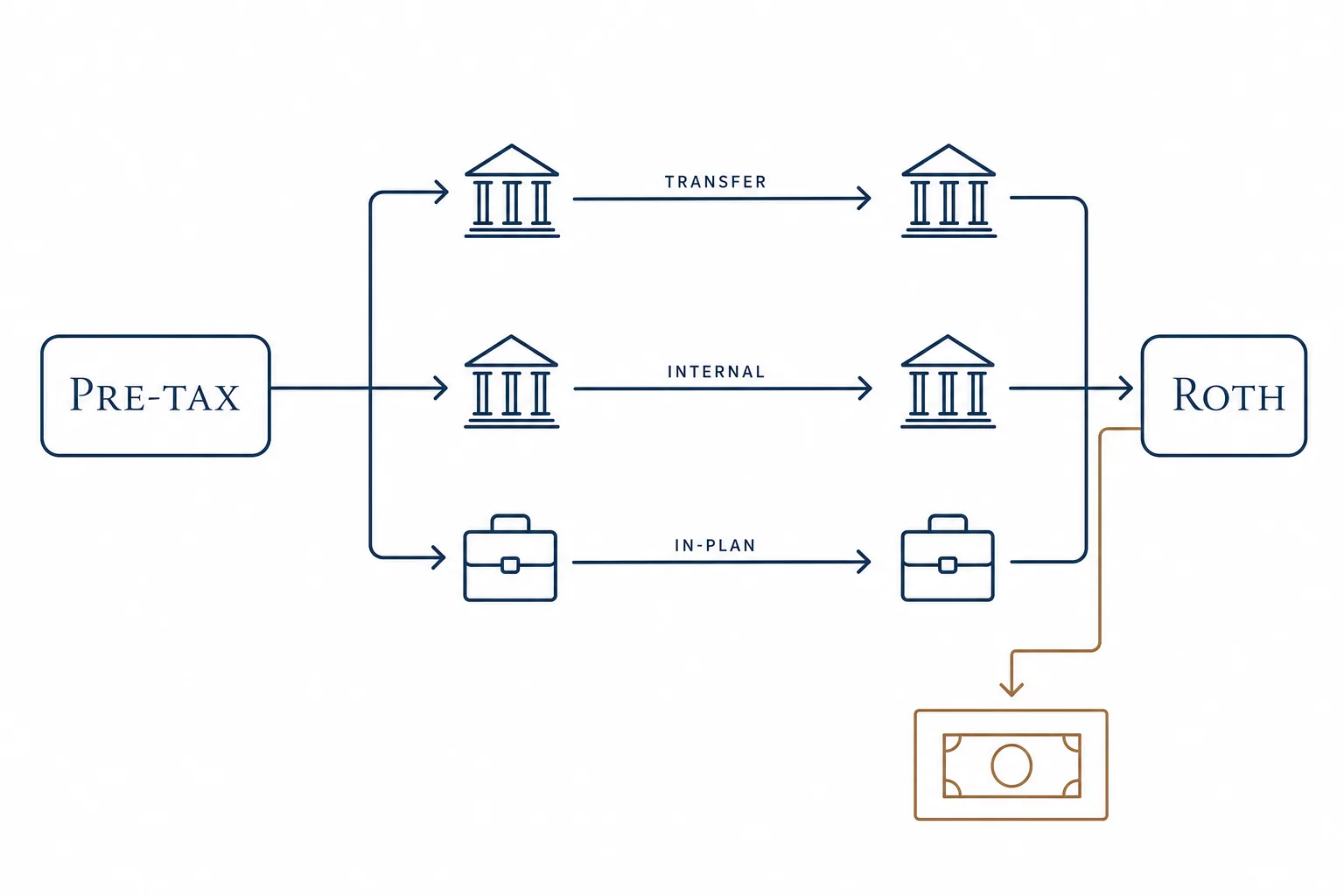
There are three common routes. You can use a direct trustee-to-trustee transfer from a traditional IRA at one custodian to a Roth IRA at another, convert internally when both accounts sit at the same custodian, or, if the workplace plan allows it, make an in-plan Roth conversion. Processing time and available options depend on the custodian and plan.
The custodian generally reports the distribution on Form 1099-R, and the converted amount may need to be reflected on your federal return. Form 8606 and other reporting may apply depending on the transaction and your basis.
Two mechanical details drive most of the outcome.
Partial conversions are allowed. You pick the dollar amount. Nothing forces you to convert an entire account, and that flexibility is what makes bracket-targeted conversions possible.
Where the tax money comes from matters enormously. Paying the tax from a taxable brokerage or cash account keeps the full converted balance compounding inside the Roth. Paying it by withholding from the conversion itself shrinks the amount that actually reaches the Roth, and if you are under age 59½, the withheld slice may be treated as a taxable distribution and may be subject to the 10% additional tax. If you cannot pay the tax from outside money, that may be a signal to convert less or wait.
Which Accounts Can Be Converted
Traditional IRAs, rollover IRAs, SEP IRAs, and SIMPLE IRAs may generally be converted, subject to applicable rules. Pre-tax balances in a 401(k), 403(b), or governmental 457(b) may also be moved to a Roth IRA or converted in the plan if the plan permits it. The IRS overview of IRA conversions explains the federal framework, but plan documents and administrator procedures still matter.
In-plan conversion availability comes down to plan document language, so ask the plan administrator rather than assuming. Before you convert anything, map what is already Roth money and what represents after-tax basis. Those dollars behave differently, and mixing them up can create avoidable tax bills.
The Rules That Trip People Up
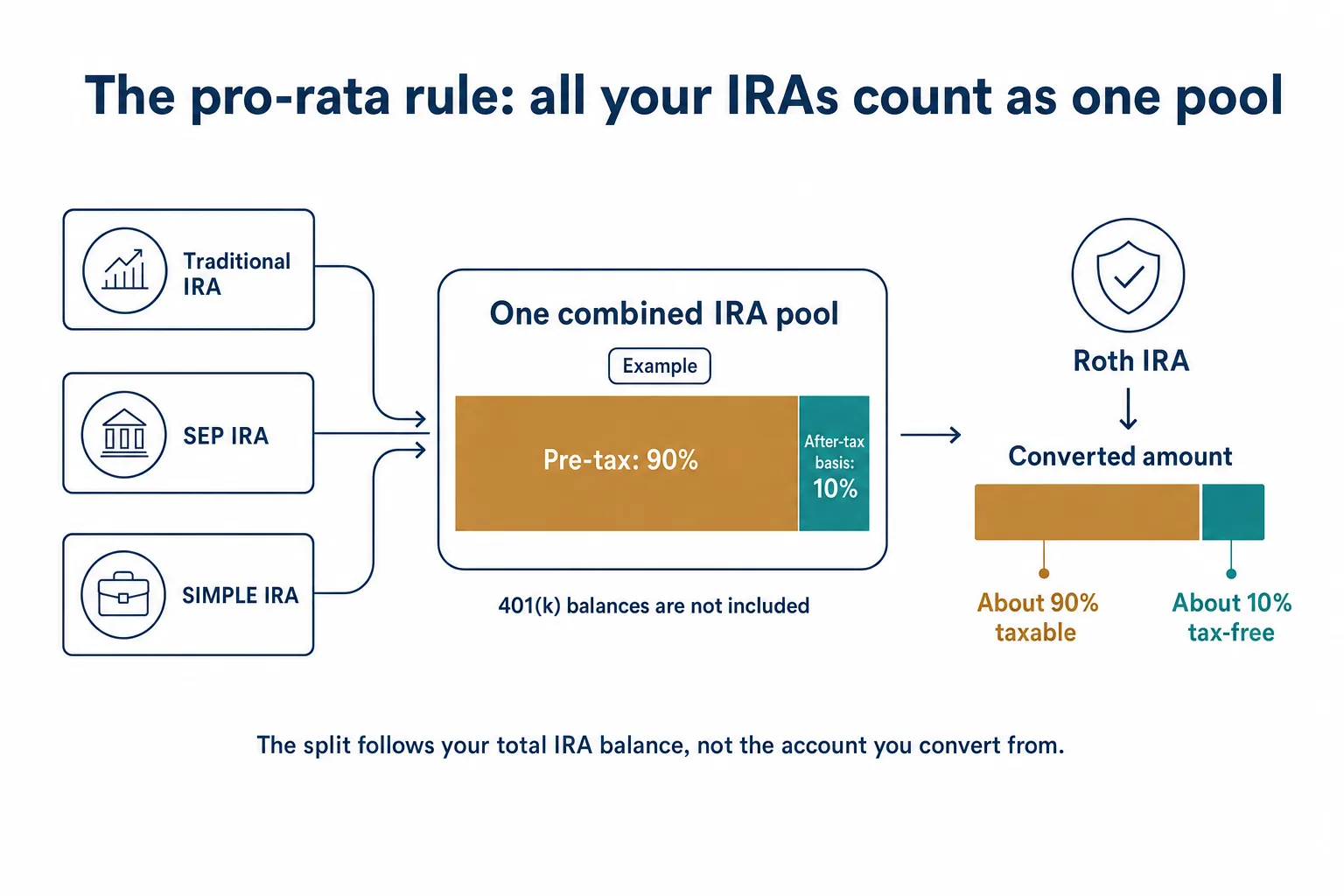
The pro-rata rule. For conversion math, the IRS treats all of your traditional, SEP, and SIMPLE IRAs as a single pool. You cannot cherry-pick the after-tax dollars and convert only those. If 90% of your combined IRA balance is pre-tax, roughly 90% of any conversion is taxable, no matter which account it came from. Note the scope: this aggregation applies to IRAs, not to 401(k) balances.
The Roth conversion 5-year rule, which is really two rules. One clock applies separately to each conversion and generally relates to the 10% additional tax on early access before age 59½. A separate Roth IRA clock affects whether earnings are qualified distributions. Exceptions and ordering rules apply, so the two clocks should not be treated as interchangeable. If you are past 59½ and have had a Roth IRA open for years, the account-level rule may be less restrictive; if you are 52 and planning to retire at 55, both clocks deserve review. The IRS explains Roth distribution and conversion rules.
A conversion cannot be undone. The ability to recharacterize a conversion was eliminated by the Tax Cuts and Jobs Act. Once you convert, you own that tax year’s decision, which is why sizing it correctly beforehand matters more than it used to.
Required minimum distributions come first. Once you reach your applicable RMD starting age, you generally must take that year’s required distribution before converting additional IRA money. An RMD itself cannot be converted. Under current IRS rules, many people begin at 73, but confirm the age and transition rules that apply to you. IRS RMD guidance should be checked before acting.
A Roth conversion itself generally has no age or income limit. Those limits for direct Roth IRA contributions are different. What changes with age is the surrounding math, not usually conversion eligibility. Roth IRAs also generally have no lifetime RMDs for the original owner, which is why conversions can surface in estate-planning conversations.
The Ripple Effects Beyond Your Bracket
Conversion income can affect more than your federal income-tax bracket. It generally increases modified adjusted gross income (MAGI), and MAGI can feed several other systems:
- Medicare premiums. A Roth conversion can affect the income used to determine Part B and Part D IRMAA. Medicare generally looks to tax data from two years earlier, so a conversion at 63 may affect premiums at 65. See Medicare’s current IRMAA guidance and confirm the year-specific amounts.
- Social Security taxation. Higher income may increase the taxable portion of your benefits. The Social Security Administration explains when benefits may be taxable.
- ACA premium tax credits. For someone retiring before Medicare eligibility and buying Marketplace coverage, a conversion can reduce or eliminate a premium tax credit because MAGI helps determine eligibility. HealthCare.gov’s MAGI definition provides the federal reference; model the effect before converting.
- The 3.8% net investment income tax. The conversion amount itself is not net investment income, but it can increase MAGI and affect whether other investment income is subject to the tax.
- The QBI deduction and state taxes. For owners still drawing pass-through income, a conversion may interact with the qualified business income deduction. If you expect to relocate, state treatment can differ between the year you convert and the year you would otherwise have withdrawn.
When a Roth Conversion Tends to Make Sense
The gap years. When someone is retired or semi-retired, before Social Security begins and before RMDs start, taxable income may dip. These years can create a planning window, but the available room depends on filing status, deductions, other income, and applicable thresholds.
A low-income year in the business. Heavy equipment purchases, a loss year, a large deductible expense, or a deliberate pause in distributions can open room to convert at a lower marginal rate.
You expect your future bracket to be as high or higher. That can come from your own future RMDs, a spouse’s income, or legislated rate changes. Paying at a known rate today has value when the alternative rate is unknown.
Market drawdowns. When balances are depressed, the same tax cost converts more shares, and any recovery happens inside the Roth. No one can predict a recovery, and future withdrawals still must satisfy applicable Roth rules.
Estate and legacy goals. Many non-spouse beneficiaries generally must withdraw an inherited IRA within 10 years, subject to exceptions and current rules. A traditional IRA can create taxable distributions for heirs; a Roth IRA may provide more tax-free distribution potential, but beneficiary rules still apply.
A concentrated tax-deferred balance. A sizable IRA may generate RMDs large enough to push you into a higher bracket in your seventies than you occupied while working.
The survivor’s tax situation. When one spouse dies, the surviving spouse may file as single, with different brackets and thresholds. Conversions completed while both spouses are living may be worth modeling against that possibility.
When It Usually Does Not
- Your current marginal rate is clearly higher than the rate you expect in retirement.
- You would have to pay the tax out of the converted balance itself.
- You are sitting just below a cliff: the top of a bracket, an IRMAA threshold, or an ACA subsidy limit. Crossing the edge can cost far more than the incremental tax.
- Your heirs are in materially lower brackets than you, or you intend to leave the pre-tax account to charity, which receives it tax-free anyway.
- You may need the converted money within five years and are under 59½.
- You are charitably inclined and eligible for qualified charitable distributions, which already move pre-tax IRA dollars out without income tax.
A short time horizon can make the upfront tax and access rules harder to justify. Model the break-even period rather than assuming a conversion will pay off.
The Roth Conversion Ladder, Explained Plainly
A Roth conversion ladder is a series of partial conversions across consecutive years instead of one lump sum. It spreads taxable income across years and can create a sequence of converted amounts with separate five-year clocks for early-retirement planning. Access before 59½ still depends on ordering rules, the applicable five-year period, and other requirements; a ladder is not a guarantee of penalty-free access.
The total converted matters less than the annual size. Each year is its own decision, made with that year’s actual income. A practical cadence is to review the numbers as income becomes reasonably knowable and allow time for custodian processing before year-end; the conversion generally belongs to the calendar year in which it is completed.
Sizing the Conversion: The Part That Decides the Outcome
The usual approach is to fill a bracket, converting up to the top of a chosen marginal bracket and stopping there. Disciplined, it prevents the most common mistake, which is converting a round number instead of the right number.
But the objective is not the lowest tax bill this year. It is the lowest lifetime tax bill across you, your spouse, and eventually your heirs. Those are different targets, and modeling them takes a multi-year projection rather than a single-year estimate.
Three practical items round it out. Confirm where the tax dollars come from and when they are due, including quarterly estimated payments. Check your safe harbor so a large conversion does not produce an underpayment penalty in April. And if you own a business, coordinate the conversion with entity income, retirement plan contributions, and any sale on the horizon.
That last point deserves its own sentence. A business sale year may already be a high-income year, so it may leave less room for a conversion; model the pre-sale, sale, and post-sale years together. This is also why the answer to “how far in advance should I start planning to sell my business” is generally years, not months: the pre-sale and post-sale years are where conversion capacity may live.
Where a Conversion Fits in a Full Financial Plan
A Roth conversion is a tax-timing decision sitting on top of everything else: asset location, withdrawal sequencing, insurance, and estate documents. Done in isolation, it is a guess. Done inside a plan, it is a lever. For context, Weston Banks describes its retirement planning as including tax-efficient withdrawals and Roth conversion strategy, and its estate-planning coordination as working alongside attorneys.
Asset location matters more than most people expect. Because qualified Roth distributions can be tax-free, holdings with higher expected growth may deserve consideration for that space, while assets throwing off ordinary income may be better placed elsewhere. For clients holding alternative or private placement investments, which carry their own liquidity and reporting characteristics, deciding which account holds what is worth making deliberately rather than by default. Weston Banks describes its approach to investment management as customized to the client’s plan.
Business owners face a different calculus than salaried retirees. Balance sheets can be concentrated and illiquid, income can be lumpy, and a single transaction can reshape a decade of tax planning. For Raleigh-area owners, business-succession planning can be coordinated with retirement income, tax, and legal conversations; the conversion decision still belongs in a broader plan.
We work with entrepreneurs and families around Raleigh on broader financial planning. Timing questions often arise around market changes, tax planning, and year-end processing, but no single calendar date makes a conversion right for everyone.
Frequently asked questions
Can I convert a traditional IRA to a Roth IRA without paying taxes?
Can I convert to a Roth after age 73?
Is there an age limit or income limit on Roth conversions?
What is the Roth conversion 5-year rule?
What does a conversion cost me right now?
What is the difference between a Roth conversion and a rollover?
Is a Roth conversion the same as a backdoor Roth?
Do Roth conversions count as income?
Can a Roth conversion affect Medicare premiums or ACA subsidies?
When should I complete a Roth conversion?
Talk Through Your Roth Conversion Options
There is no universal answer to whether you should convert, and anyone offering one without seeing your return is guessing. What is knowable is your own picture: current balances, cash flow, this year’s projected income, the shape of your future RMDs, and how a sale or a retirement date changes all of it.
Weston Banks’ planning process can bring those inputs together: current balances, cash flow, projected income, future RMDs, and how a sale or retirement date changes the picture. The firm says it works alongside tax and legal professionals; it does not replace them. If you want to discuss your situation, book a call with Weston Banks.
If you would like a sense of how the firm approaches planning, start with the Education section or About Weston Banks. Then bring your actual numbers to a conversation about what the years ahead may support.