
Most of the money lost in a family handoff isn’t lost in the transfer itself. It leaks out through avoidable taxes, a rushed valuation, or a plan that forgets to fund your own retirement. So when a Raleigh business owner asks how do I transfer my business to a family member without losing money, the honest answer is that the outcome depends far more on how you transfer than on whether you do. The right method, matched to your tax picture and income needs, keeps the value in the family instead of handing it to the IRS.
What “Losing Money” Actually Means in a Family Business Transfer
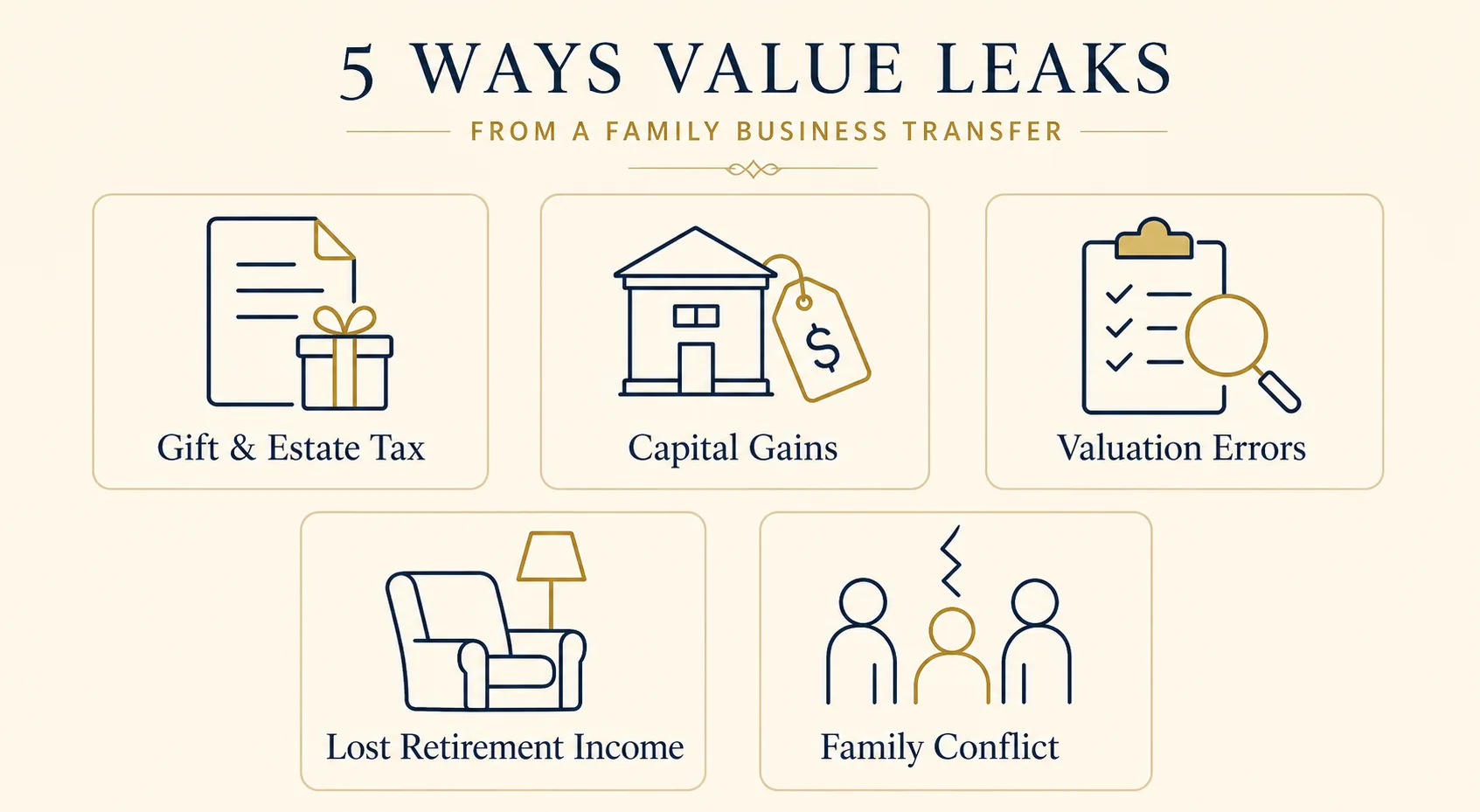
Before choosing a method, name where the money goes. Value tends to leak through five channels:
- Gift and estate tax on transfers above annual and lifetime limits
- Capital gains tax when the business is sold or its basis is mishandled
- Undervaluation or overvaluation, both of which invite IRS scrutiny or strain the successor
- Lost income if the transfer leaves you without enough to fund retirement
- Family conflict, quietly the most expensive line of all
The U.S. Small Business Administration’s guidance on closing or selling a business treats a smooth transition as a process, not a single signature. Treating it that way is the first step toward protecting the money.
How Do I Transfer My Business to a Family Member Without Losing Money? Compare the Four Methods
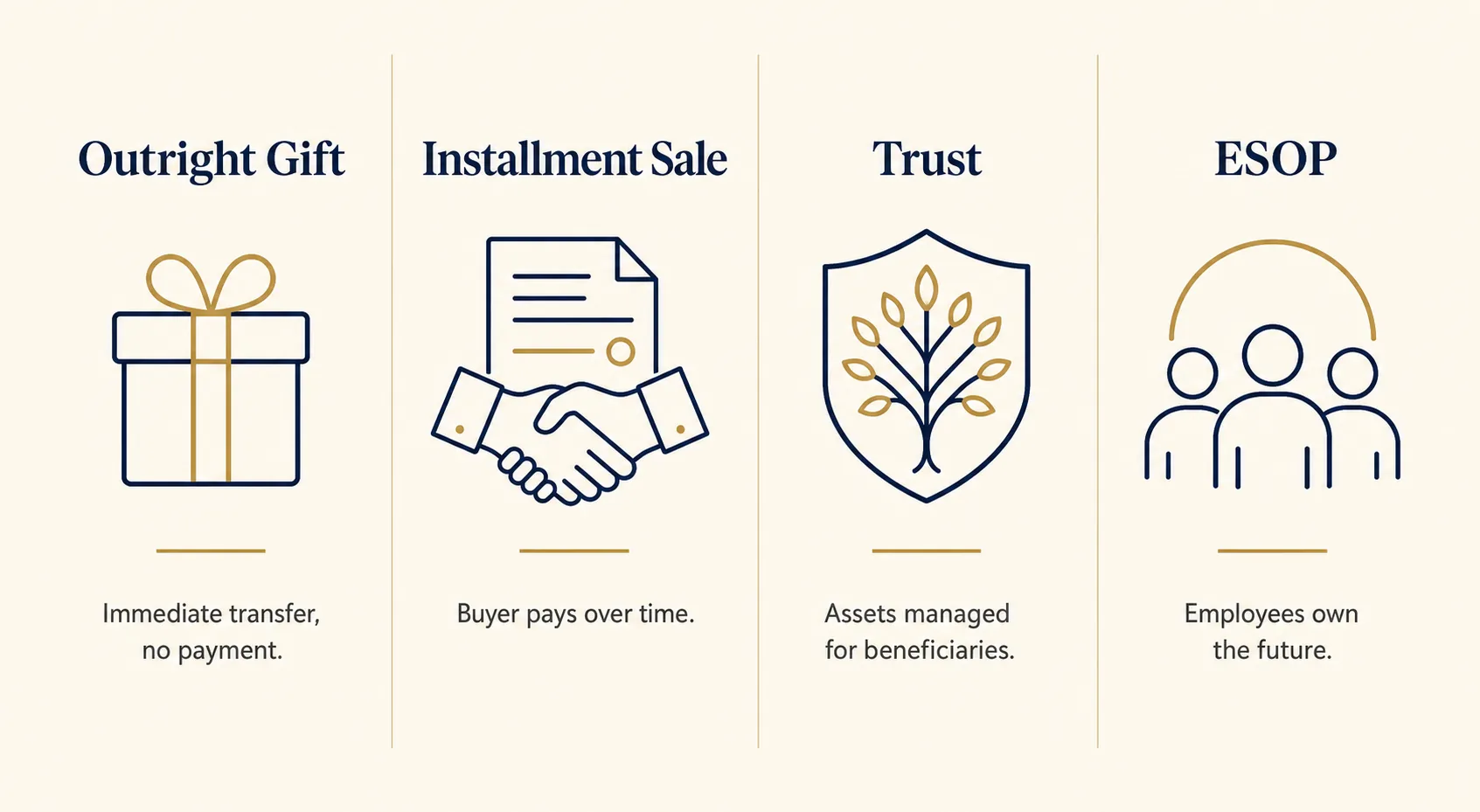
There’s no single “best way to transfer a business to a child.” There are four workable paths, each with a different tax and cash-flow profile.
| Method | How it works | Tax impact | Best when | Watch-outs |
|---|---|---|---|---|
| Outright gift | You transfer ownership without payment | Uses gift-tax exclusions; recipient owes no income tax | You have estate-tax room and don’t need sale proceeds | Carryover basis can raise the heir’s future gains |
| Sale (installment note) | Family member buys in over time | Capital gains spread across years | You need retirement income from the business | Must be at fair market value |
| Trust (GRAT/IDGT) | Ownership moves into a trust structure | Freezes value; can reduce estate tax | High-value business, growth expected | Needs professional design |
| ESOP | Employees buy the company | Potential tax deferral for the seller | No family successor is ready | Complex, better for larger firms |
Gifting the business to a family member
Gifting is the cleanest route when you don’t need cash from the deal. You can gift shares up to the annual exclusion each year and tap the lifetime exemption beyond that, and the recipient generally owes no income tax on the gift itself. You can also gift an LLC to a family member by assigning membership interests through the operating agreement. The trade-off is the basis of assets: a gifted business carries your original cost basis, so the size and timing of each gift deserve careful thought before you move shares. Spreading gifts across several years is often what keeps them efficient.
Selling to a family member without losing money
A sale lets you draw income while passing the company on. The catch that surprises many owners: you can’t just sell your business to your son for $1. The IRS treats any sale below fair market value as a partial gift, and the difference becomes taxable gift value. Under bargain sale rules, the IRS treats any sale below fair market value as a partial gift, and the difference becomes taxable gift value. An installment sale, where your successor pays over several years, spreads your capital gains and can smooth their cash flow. Done at a defensible price, it’s frequently the most balanced answer for owners who still need the proceeds.
Using a trust to transfer ownership
Trusts such as a GRAT or intentionally defective grantor trust let you move a growing business out of your taxable estate while you keep an income stream for a set period. You “freeze” today’s value for estate-tax purposes and let future growth pass to the next generation at a lower cost. These structures reward early planning and professional design.
ESOP as an alternative
If no family member is ready to lead, an Employee Stock Ownership Plan lets your team gradually buy the company, often with meaningful tax deferral for you. It’s more complex and better suited to established firms, but it keeps the business independent. Research on family business succession consistently finds that a prepared, capable successor is what preserves a company’s value through the handoff, so successor readiness belongs at the center of whichever method you pick.
Set the Right Value, Why a Proper Business Valuation Protects You
Valuation is where money is quietly won or lost. Price it too low and you invite gift-tax exposure and IRS questions. Price it too high and your successor can’t afford the payments, straining the very business you’re trying to preserve. A qualified, independent appraisal gives you a defensible fair purchase price and a foundation for the tax strategy around it. This is where comprehensive planning earns its keep, coordinating the valuation with the transfer structure so the numbers work on both sides.
Valuation is where money is quietly won or lost.
How Far in Advance Should You Start Planning to Sell or Transfer Your Business?
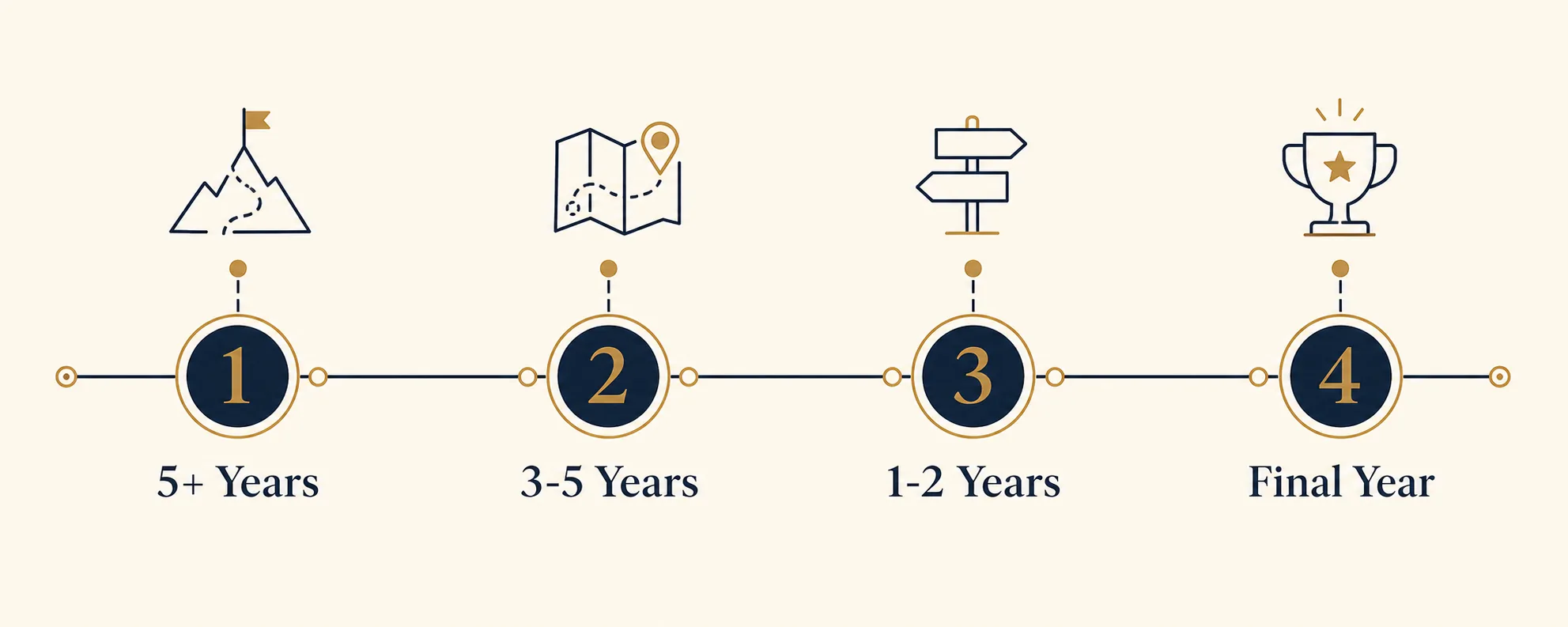
Start earlier than feels necessary. Multi-year gifting, trust setup, and grooming a successor all reward runway.
| Timeline | Focus |
|---|---|
| 5+ years out | Choose a successor, begin annual gifting, set valuation baseline |
| 3–5 years out | Build the transfer structure, draft agreements, plan taxes |
| 1–2 years out | Train the successor, finalize documents |
| Final year | Execute the transfer, coordinate retirement income |
The question many owners skip: will the transfer still fund your lifestyle? Sale proceeds and any retained interest need to be invested so your income holds up through retirement.
Prepare the Successor and the Paperwork

A son or daughter taking over the family business needs time in the seat, not just a title. Alongside grooming the successor, the transfer runs on real documents: a buy-sell agreement, an assignment of ownership interest, and updates to the operating agreement. Plenty of “business transfer of ownership form” templates float around online, but a downloadable form can’t account for your valuation, tax basis, or estate plan. This is work to do with a professional, not a fill-in-the-blank file.
The step most plans miss is retirement-income coordination, investing the proceeds so your standard of living continues long after the keys change hands.
Common Mistakes That Cost Families Money
- Selling to a child for $1 and triggering gift tax
- Skipping an independent valuation
- Operating without a buy-sell agreement
- Ignoring capital-gains basis on gifted interests
- Leaving no plan for the owner’s post-transfer income
- Rushing the deal during a market or tax-timing crunch
Year-end and the weeks around tax day are when these gaps surface. Planning ahead of those windows keeps you in control of the timing rather than reacting to it.
How Weston Banks Helps Raleigh Business Owners Transfer Wealth
Weston Banks Wealth Partners builds comprehensive, tax-forward plans for business owners across Raleigh and beyond. That means coordinating valuation, transfer structure, and, crucially, the investment of your proceeds so your lifestyle is protected for the long run. For qualified clients, we also draw on alternative and private placement investment options that many firms don’t offer or fully use, and our advisory management keeps your plan aligned as circumstances change. Explore our What We Do and Education pages, or visit Who We Are to see how we work with families and entrepreneurs.
Frequently asked questions
Can I sell my business to my son for $1?
Can you gift an LLC to a family member?
What’s the best way to transfer a business to a child without a big tax bill?
How far in advance should I start planning to sell my business?
Do I need a business transfer of ownership form or template?
Key Takeaway
The value in your business isn’t lost in the handoff, it’s lost in the decisions around it. Match the method to your valuation, your tax situation, and your retirement-income needs, and the money you spent a career building stays with the family it was meant for.