
Two partners build a profitable Raleigh business together. One dies unexpectedly, and overnight his spouse becomes a co-owner who has never run the company. Should the surviving partner buy her out? At what price? With what cash? If those questions make you uneasy, you are already asking what is a buy-sell agreement and do I need one. This guide defines the term in plain English, walks through the main types and how they are funded, and gives you a short checklist to decide whether your business actually needs one.
What Is a Buy-Sell Agreement? (Plain-English Definition)
A buy-sell agreement is a legally binding contract that spells out when, to whom, and at what price an owner’s share of a business will transfer when a specific event happens. Think of it as a set of instructions that activates the moment an owner dies, becomes disabled, retires, divorces, or decides to walk away.
People call it different things, a “business will,” a “business prenup,” or simply a buyout agreement. The goal is the same: keep ownership out of the wrong hands and out of court. As the Legal Information Institute at Cornell Law School explains, these agreements place limits on the ownership rights of closely held companies, typically requiring that shares be sold back to the business or the remaining owners rather than to outsiders.
How a Buy-Sell Agreement Works
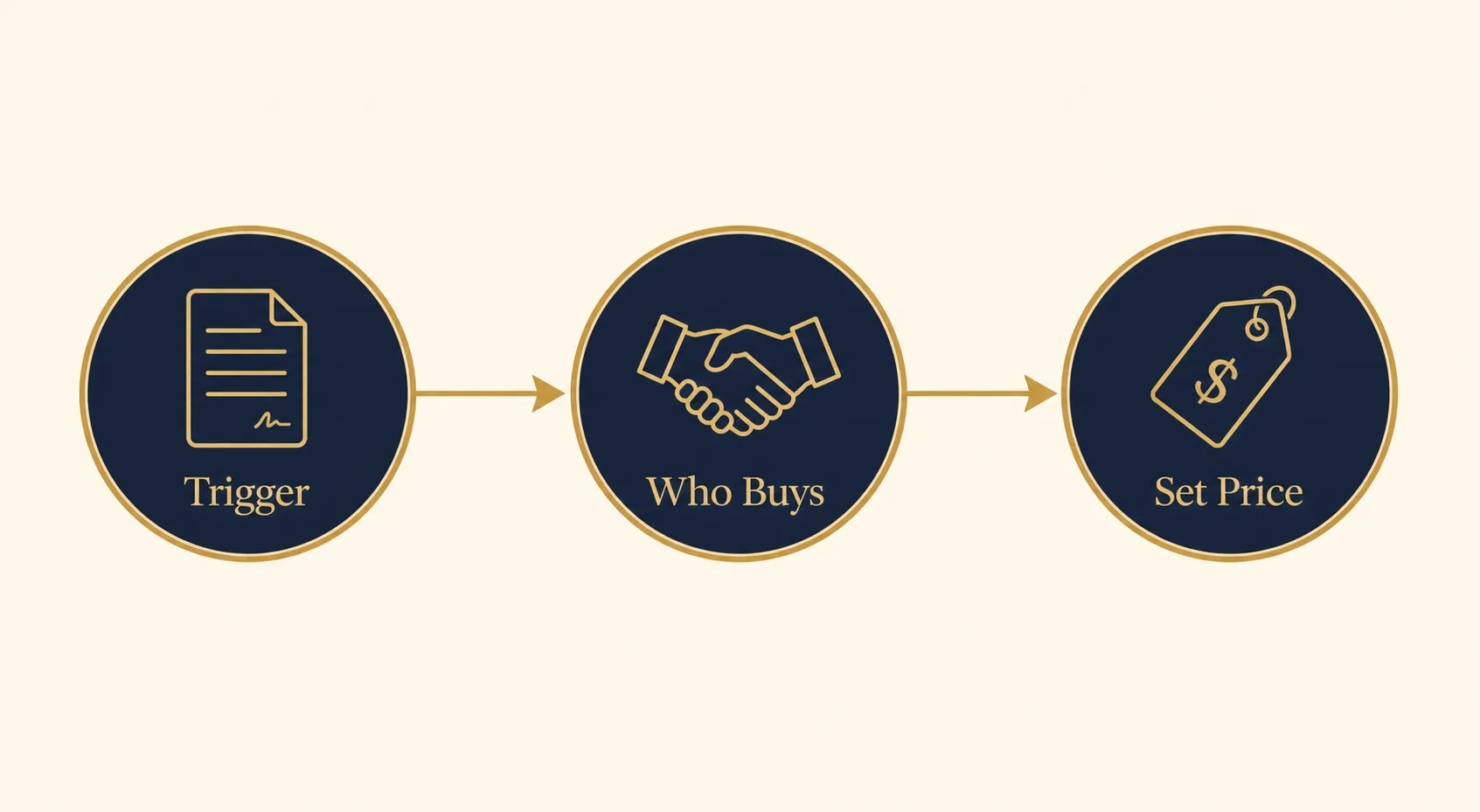
The agreement sits in the background until a defined event pulls the trigger. At that point it dictates who has the right (or the obligation) to buy, and it fixes how the price is set. Two components do most of the work.
Triggering Events
These are the circumstances that activate a buyout. Common ones include:
- Death of an owner
- Long-term disability or incapacity
- Retirement
- Divorce (to keep an ex-spouse out of the cap table)
- Personal bankruptcy
- A voluntary decision to sell or exit
A thorough agreement names each event and states exactly what happens next, so no one is left guessing during an already stressful moment.
Setting the Price and Valuation Methods
Price disputes wreck more buyouts than anything else. The agreement should lock in a valuation method up front. Three approaches are common: a fixed price, a formula (for example, a multiple of earnings), and an independent appraisal at the time of the event. A stale number is dangerous, a value agreed to five years ago rarely reflects what a growing company is worth today. The price your agreement sets can also shape how the business interest is valued for estate-tax purposes under the Section 2703 valuation rules, which is one reason valuation deserves careful, coordinated attention rather than a guess.
Types of Buy-Sell Agreements
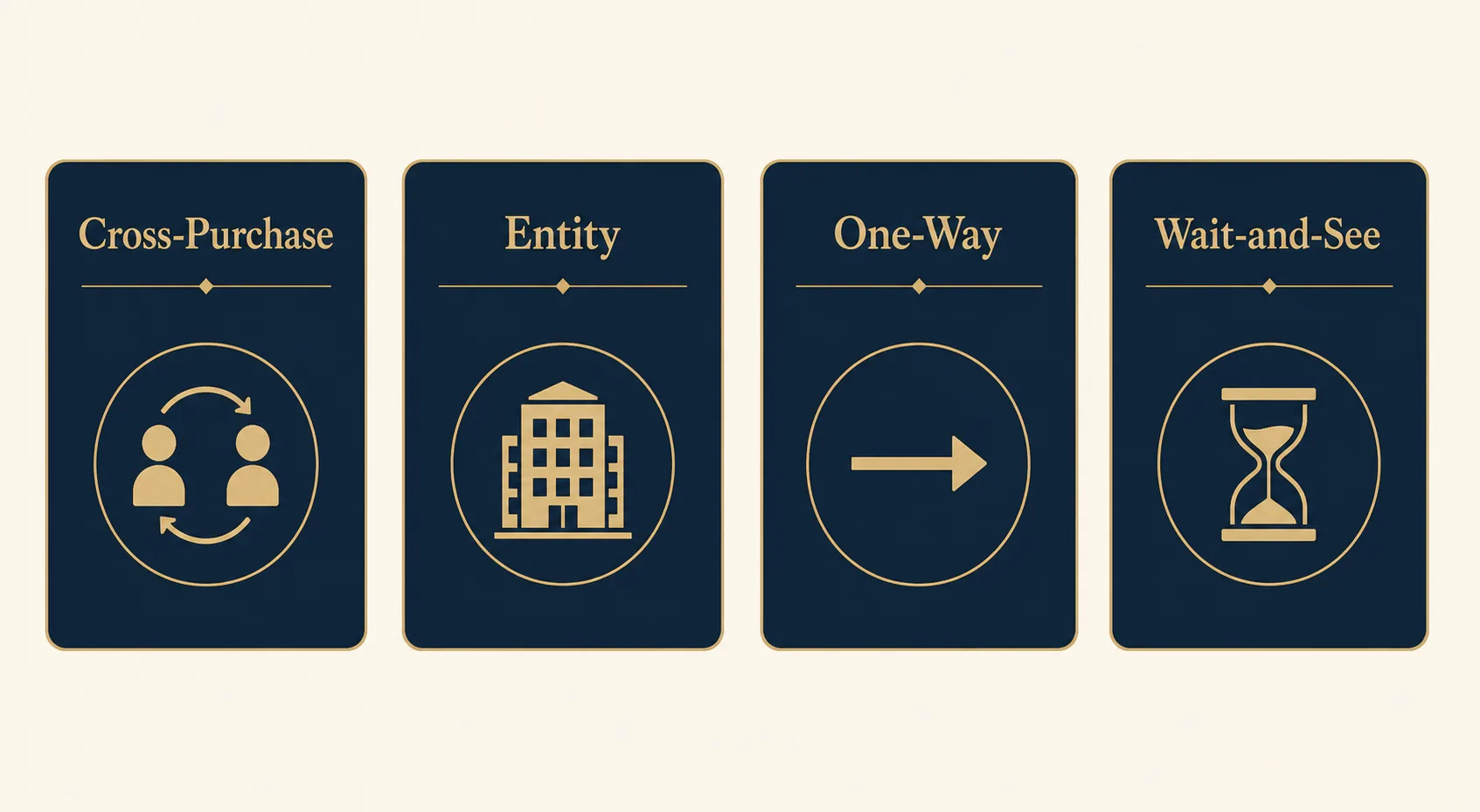
A one-way buy-sell agreement suits a sole owner who has identified a single successor, often a family member or trusted employee. If that successor is a key employee, understanding how to sell a business to a key employee can help you structure the transaction, financing, and ownership transfer more effectively. The wait-and-see approach delays the choice until the event actually occurs.
| Type | Who buys the share | Best fit |
|---|---|---|
| Cross-purchase | Remaining owners individually | 2–3 owners |
| Entity / redemption | The business itself | Multiple owners |
| One-way | A single designated buyer (e.g., a key employee) | Sole owner with a chosen successor |
| Wait-and-see / hybrid | Decided at the triggering event | Owners who want flexibility |
A cross-purchase buy-sell agreement works well for a small ownership group where each partner buys the departing owner’s share directly. An entity or redemption agreement puts the buying obligation on the company, which simplifies things when there are several owners. A one-way buy-sell agreement suits a sole owner who has identified a single successor, often a family member or trusted employee. The wait-and-see approach delays the choice until the event actually occurs.
How Buy-Sell Agreements Are Funded
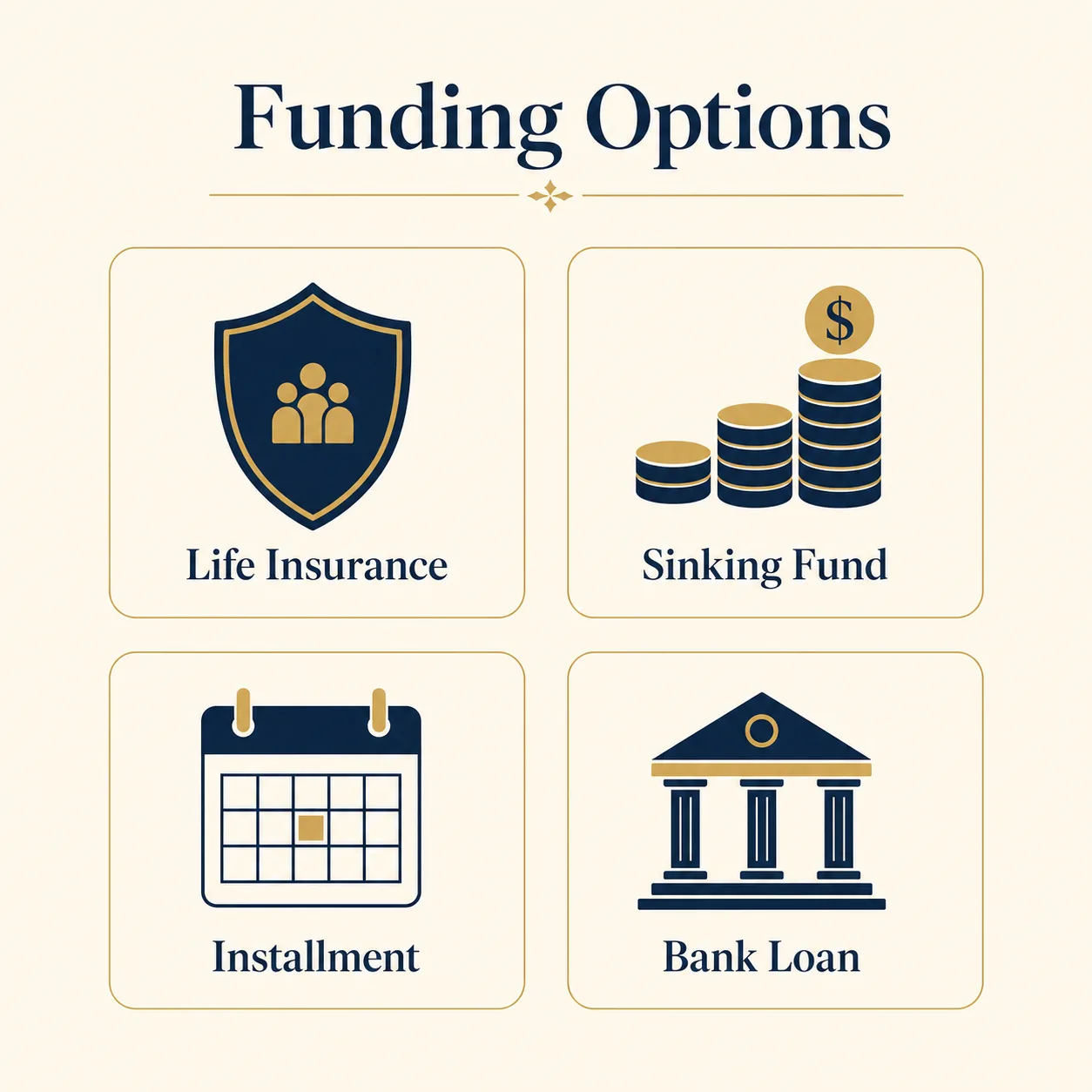
An agreement nobody can afford to honor is just paper. Funding is what turns the promise into cash on the day it is needed.
Life Insurance Funding
This directly answers a question many owners ask: what is a buy-sell agreement in life insurance? Here, the business or the owners hold life insurance policies on each other. When an owner dies, the policy pays a death benefit that funds the buyout. The surviving owners get liquidity to purchase the shares, and the deceased owner’s family receives fair value, without draining the company’s operating cash.
Other Funding Options
Life insurance is not the only route:
- Sinking fund, the business sets aside cash over time.
- Installment sale, the buyer pays the departing owner over several years.
- Bank loan, external financing covers the purchase, repaid from future profits.
Each option carries different cash-flow and risk trade-offs, which is why funding deserves as much attention as the legal language. For owners with more complex balance sheets, liquidity can also come from investment strategies beyond a single policy, an area where tax-aware, advisory-led planning earns its keep.
An agreement nobody can afford to honor is just paper.
Do I Need a Buy-Sell Agreement? (A Simple Checklist)

Here is the practical half of what is a buy-sell agreement and do I need one. The answer usually turns on how ownership is shared and how much of your net worth is tied up in the business.
Signs You Need a Buy-Sell Agreement Now
Answer yes or no:
- Do you have one or more co-owners?
- Are family members involved in the ownership or the business?
- Is the business your single largest asset?
- Would you struggle to pay cash to buy out a partner’s heirs?
- Do you want control over who becomes a future co-owner?
Several “yes” answers are a strong signal that you need an agreement in place before, not after, something happens.
One clarification, because search results mix these up: a real-estate buy-sell agreement and a car buy-sell agreement are simply purchase contracts for a property or a vehicle. This article covers the business ownership version, the contract that governs what happens to your stake in a company. If you came looking for a property or auto purchase form, that is a different document entirely.
Buy-Sell Agreements and Business Exit Timing
Owners often ask how far in advance they should start planning to sell a business. The honest answer is years, not months. Valuation needs time to reflect clean financials, funding sources like insurance take time to mature, and tax positioning cannot be fixed overnight. A buy-sell agreement is one piece of a larger succession plan, the earlier it is drafted and funded, the more options you keep. Starting three to five years ahead of a hoped-for exit gives the numbers, the funding, and the paperwork room to line up.
The Tax and Estate Planning Angle
A well-built agreement does more than move shares. It can create the liquidity an estate needs to cover taxes, establish a defensible value for the ownership interest, and coordinate with the rest of the owner’s estate plan so heirs are not forced into a fire sale. Drafted in isolation, an agreement can contradict a will or a trust. Built as part of comprehensive planning that weighs tax strategy alongside the legal terms, it protects both the company and the family, the difference between a document that exists and one you can actually rely on.
Templates vs. a Professionally Drafted Agreement
Search for a buy-sell agreement template, a buy-sell agreement PDF, or a free buy-sell agreement template and you will find plenty. A template can help you learn the structure and vocabulary. Where a generic download falls short is the detail that actually matters: a valuation clause that will not spark a dispute, a realistic funding mechanism, coordination with your tax and estate plan, and compliance with North Carolina law. Professional review is what turns a fill-in-the-blank form into an agreement that holds up when it is finally needed.
Frequently asked questions
What is a buy-sell agreement in simple terms?
What is the difference between a cross-purchase and an entity buy-sell agreement?
Is a buy-sell agreement the same as a will?
How is a buy-sell agreement funded with life insurance?
Do I need a lawyer or a financial advisor to set one up?
Key Takeaway
If you share ownership of a business, or the business is a major part of your net worth, you very likely need a buy-sell agreement, and it works best as one part of a coordinated succession, tax, and estate plan rather than a standalone form. Weston Banks helps Raleigh business owners connect the agreement to the bigger picture, so the plan protects both the company and the family that depends on it. If you are weighing a future exit or simply want your ownership questions answered clearly, our team is glad to start that conversation.