
You spend years building a company, and the offer finally arrives: part cash at closing, the rest paid over five years. That structure may be an installment sale for federal tax purposes. For eligible gain, it generally changes when you recognize the gain; it doesn’t eliminate tax, and some income may be recognized in the sale year. For an owner carrying paper for a buyer, that timing often decides whether the tax bill lands before the money does.
What follows is general education, not personalized tax or legal advice. Your own numbers deserve a conversation with your CPA and attorney.
What Is an Installment Sale for Tax Purposes?
Section 453 of the Internal Revenue Code and related IRS guidance govern the federal installment method. IRS Topic 705 defines an installment sale as a sale of property where at least one payment is received after the tax year in which the sale occurs. The threshold is generally one payment received after the tax year of sale.
For eligible gain, the installment method generally recognizes gain as principal payments are received or treated as received. Interest and certain ordinary-income items, including depreciation recapture, follow separate rules. A seller who takes 20% down and collects the balance over several years may spread recognition across multiple tax years, but the result depends on the transaction and the seller’s broader tax situation.
This can matter to a business owner selling company assets or business real estate. In some cases, a partnership-interest sale may also involve installment rules, but the treatment depends on the transaction and the assets involved. Weston Banks also discusses this type of decision in its business-succession planning work.
Quick answer: An installment sale is a sale of property in which at least one payment is received after the tax year of sale. Under the federal installment method, eligible gain is generally recognized as payments are received or treated as received. Inventory, losses, depreciation recapture, interest, debt, and other amounts may follow different rules.
How Installment-Sale Payments Are Taxed

A payment may include principal applied to basis recovery, eligible gain, and interest; other amounts can be treated separately under the tax rules.
Return of basis. Your adjusted basis is the amount you have invested in the property for tax purposes, as adjusted over time. It may reflect cost, improvements, depreciation, and other fact-specific adjustments. The return of adjusted basis generally is not income, but the calculation can be more complex for business or depreciated property.
Gain. Eligible gain is often capital gain, but asset character and rules such as depreciation recapture can produce ordinary or separately treated income. Its size depends on your gross profit percentage.
Interest. The buyer is paying over time, so the note carries interest. If the stated rate is too low, the rules can impute interest anyway. Interest is ordinary income, taxed at your regular rates and reported separately from the gain.
Sellers fixed on the headline price often miss that the interest piece is taxed less favorably than the gain piece. How a deal splits between price and rate has real consequences.
How to Calculate the Gross Profit Percentage
For a simplified transaction, gross profit begins with the selling price minus adjusted basis, selling expenses, and any amount treated separately as depreciation recapture. The IRS explains the basis and gross-profit calculation in Publication 537.
Contract price is a tax calculation, not simply the cash you expect to collect. Depending on the transaction, the selling price and contract price can reflect money or property received, debt the buyer assumes or takes subject to, buyer-paid selling expenses, and adjustments for interest. Gross profit divided by contract price gives the gross profit percentage, which generally applies to each eligible principal dollar you later receive.
A simplified illustration, not a projection of anyone’s result: you sell business real estate for $1,000,000 with a $400,000 basis and no debt attached. Gross profit is $600,000, so the percentage is 60%. On a $200,000 down payment, $120,000 is taxable gain and $80,000 is a simplified return of basis that is generally not included in income; the example excludes debt, recapture, interest-calculation complications, and other fact-specific rules. Each additional $200,000 of principal splits the same way, with interest reported on top.
Debt complicates it. If the buyer assumes a mortgage that exceeds your basis, the excess is generally treated as a payment received in the year of sale, which can create taxable gain up front even though little cash changed hands.
Debt can change the result. When a buyer assumes a mortgage or takes property subject to debt, the debt may be treated as payment and may create gain in the year of sale even when little cash changes hands. The exact calculation depends on the property’s basis, the debt, and the transaction terms.
What Property Qualifies, and What Does Not
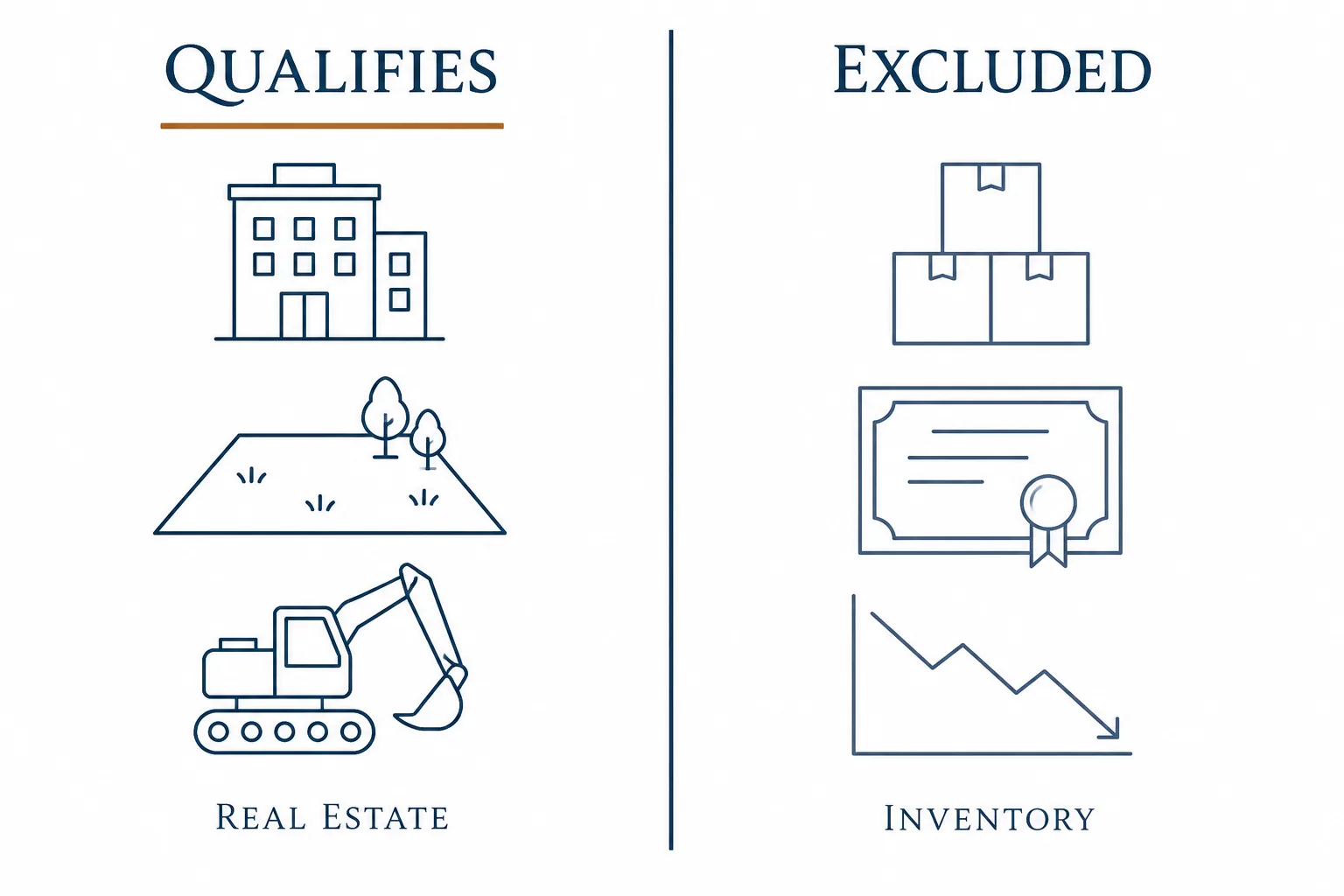
Commonly eligible: real estate, land, buildings, closely held business interests, and equipment sold as part of a business.
Generally excluded: inventory and dealer dispositions, stock and securities traded on an established market, and any sale that produces a loss, which is recognized in the year of sale rather than spread.
Two wrinkles catch business sellers. In an asset sale, the tax analysis generally follows the separate assets and the agreed allocation, so inventory, receivables, depreciated property, goodwill, and real estate can have different treatment. And depreciation recapture is generally recognized in the year of sale whether or not cash arrived to cover it. An owner who depreciated equipment aggressively can owe tax in year one on income they will not collect until year four. That is a cash-flow problem worth modeling before signing, not after.
For general background on sales of business assets, see IRS Publication 544. Your CPA should determine how the specific assets in a transaction are treated.
Business-sale assets may not receive the same tax treatment
| Asset or amount | General planning question |
|---|---|
| Inventory | Does the sale produce ordinary income that must be reported in the sale year rather than through installment reporting? |
| Accounts receivable | Will the receivables be treated separately from eligible installment gain? |
| Depreciated equipment | How much depreciation recapture may be recognized immediately, and what remaining gain may be treated differently? |
| Goodwill or other intangible assets | How does the purchase-price allocation affect the character and timing of the gain? |
| Business real estate | How do basis, selling expenses, debt, recapture, and the note terms affect the calculation? |
A business sale should therefore be reviewed asset by asset rather than treated as one undivided gain.
How to Report an Installment Sale: Form 6252
When the installment method applies, IRS Form 6252 is generally used to report installment-sale income. Form 6252 is generally filed for the year the sale occurs and for each later year of the installment obligation when reporting is required. The gain generally flows to Schedule D or Form 4797, while the interest is reported as ordinary income.
A note that runs five or ten years demands records that survive that long: the amortization schedule, your basis documentation, and the purchase price allocation among assets that the parties agreed to at closing. Set up a recordkeeping process at closing for the note, basis, allocation, principal, interest, and payment history; later reporting is easier when those records are complete.
Electing Out of the Installment Method
Installment reporting is the default. To recognize all the gain in the year of sale instead, you generally must elect out by the due date of the sale-year return, including extensions.
Electing out can make sense in an unusually low-income year, when expiring capital losses or net operating losses can absorb the gain, when you expect higher rates later, or when you have genuine doubt about the buyer’s ability to pay. The trade-off is blunt: tax comes due before the installments arrive. Because reversing the election may be limited, the decision deserves modeling well ahead of the filing deadline.
Installment-Sale Risks Sellers Should Model
Buyer default. A buyer default or repossession can create new gain, loss, and basis questions. Do not assume the original payment schedule determines the tax result after the note changes.
The Section 453A interest charge. For certain large installment obligations, Section 453A can impose an interest charge on deferred tax. The threshold and exceptions are technical; the statutory text should be reviewed with a tax professional rather than reduced to a universal rule.
Pledging the note. Using the installment obligation as collateral for a loan can accelerate gain recognition, which surprises sellers who treat the note as ordinary borrowing power.
Related-party resales. Certain related-party resales can accelerate deferred gain, so the relationship, asset, timing, and transaction should be reviewed before closing.
Rate risk. Deferral does not guarantee lower total tax. Future rates, your future income, the buyer’s performance, and the note’s terms can all affect the result.
State treatment. State treatment can differ from federal treatment, and a move during the note period can create state-sourcing or filing questions. Ask a state-tax professional to review the seller’s residence, the property’s location, and the payment history.
Installment Sale vs. Seller Financing
The two terms get used interchangeably, but they are not the same. Seller financing is the deal structure: you carry a note instead of getting cashed out. The installment method is the tax accounting that usually rides along with it. A seller-financed deal can exist without installment treatment if you elect out.
The terms that drive your tax outcome are negotiated early: down payment size, note term, stated interest rate compared with the applicable federal rate, and what security or personal guarantees stand behind the promise.
Where an Installment Sale Fits in Your Financial Plan
An installment note is a multi-year income stream, an uninvested asset, and a concentration risk at once, since a large share of your net worth may rest on one buyer’s ability to perform.
That is where the planning work lives. Those payments may need to be coordinated with retirement-income planning, charitable intentions, estate-planning coordination, and investment management rather than simply deposited. Owners who start this analysis a few years ahead of a sale may have more room to evaluate the deal structure and the portfolio it will fund. Owners who start after closing are working with whatever they signed.
Weston Banks works with business owners on the financial side of succession, including capital-gains planning, post-sale investment planning, retirement-income planning, and coordination with the client’s CPA and attorney.
Questions to Ask Before You Sign
Before agreeing to an installment note, ask your CPA, attorney, and financial adviser:
- Which assets in the transaction may qualify for installment treatment, and which may create immediate income?
- How will the purchase price be allocated among inventory, receivables, equipment, goodwill, real estate, and other assets?
- Will the down payment cover the tax that may be due in the first year, including recapture or debt-related income?
- Does the note charge adequate interest, and what security, guarantees, default terms, and prepayment terms protect the seller?
- What happens if the note is pledged, transferred, modified, forgiven, or paid early?
- How will the note fit with retirement income, investments, estate documents, and state filing obligations?
Installment Sale FAQs
Related readingHow to Sell a Business to a Key Employee | Weston BanksRead the guide →Frequently asked questions
How far in advance should I start planning to sell my business?
Does an installment sale lower my total tax bill or only spread it out?
What happens to the note if I die before it is paid off?
Can I sell the installment note later for a lump sum?
Do I still report interest if the note charges little or no interest?
Discuss Your Sale Before You Sign
If a sale is on your horizon, the useful next step is to book a call before the terms are locked. We can discuss the financial questions raised by the proposed terms, including cash flow, proceeds, investment needs, and retirement income, while your CPA and attorney handle tax and legal specifics.
Learn more about how Weston Banks works and browse the Education library for related planning topics. Coordinate the specifics with your CPA and attorney; we are glad to work alongside them.