
The 4% rule is a historical retirement-income guideline. It starts with a withdrawal equal to 4% of your investment portfolio in year one, then increases that same dollar amount with inflation. It was developed around roughly 30-year historical scenarios, so it is a starting benchmark, not a guarantee or complete retirement plan.
You may be approaching retirement with a portfolio, a business, or both. The practical question is how much you can spend each year while keeping the rest of your plan on track. The 4% rule offers a widely used starting point, but it is not a complete retirement-income plan.
What the 4% Rule Means for Retirement Withdrawals
Withdraw 4% of your total investment portfolio in your first year of retirement, then adjust that same dollar amount for inflation every year after. After year one, you are not taking 4% of your current balance; you are raising the original dollar figure by inflation, regardless of what markets did. Historical research has tested this approach over approximately 30-year periods, but it is a benchmark rather than a guarantee or a complete withdrawal policy.
How to Calculate a 4% Retirement Withdrawal
- Add up your investable retirement assets. 401(k), IRA, rollover accounts, taxable brokerage. Not your house, not a business you still own.
- Multiply by 0.04. That is your first-year withdrawal.
- Each following year, raise the prior year’s dollar amount by inflation.
A $1,000,000 portfolio produces $40,000 in year one. If inflation runs 3%, year two is $41,200, whether the market gained 20% or lost 15%. That fixed-dollar approach is what the historical test evaluated, but it can be inflexible when spending needs or market conditions change.
A $500,000 portfolio would produce a $20,000 first-year withdrawal; under the model’s assumptions, that amount is tested over roughly 30 years. That is a starting estimate, not a complete retirement-income plan, so Social Security, pension income, taxes, spending needs, and other sources should be mapped alongside it.
Run the same math backwards, and you get the 25x rule: multiply the annual spending your portfolio has to cover by 25 to get a target nest egg. If the portfolio must fund $120,000 a year after other income, the implied target is $3 million.
The basic rule is that you sell 4% of your portfolio the first year. This gives you a certain $ amount to cover your living expenses for that …Read on Reddit ↗
4% Rule Examples at a Glance
Use the same first-year calculation for any portfolio size:
| Investment portfolio | 4% first-year withdrawal |
|---|---|
| $500,000 | $20,000 |
| $1,000,000 | $40,000 |
| $2,000,000 | $80,000 |
4% Rule vs. a Personalized Withdrawal Plan
The 4% rule can provide a starting estimate. A personalized plan also considers your spending, other income, taxes, account types, time horizon, investment mix, and legacy goals.
| 4% rule | Personalized withdrawal plan |
|---|---|
| Starts with a portfolio percentage | Starts with actual spending needs |
| Uses a historical withdrawal framework | Includes taxes and other income |
| Assumes an approximately 30-year horizon | Adjusts for longevity and retirement age |
| Does not account for every major expense | Can include health, family, charitable, and legacy goals |
| Provides a starting estimate | Creates a strategy to review and adjust |
Where the 4% Rule Came From, and What It Assumes
William Bengen published the historical-return research behind the guideline in a 1994 Journal of Financial Planning paper, “Determining Withdrawal Rates Using Historical Data.” The original paper tested withdrawal rates against historical U.S. market returns.
Academic work followed. The 1998 Trinity Study by Cooley, Hubbard, and Walz tested 10 withdrawal rates across five portfolio allocations and four payout periods using annual stock and bond returns from 1926 to 1995.
In practical terms, the historical framework reflects a diversified stock-and-bond portfolio, an approximately 30-year horizon, U.S. historical return sequences, and disciplined rebalancing. The treatment of taxes and fees depends on the model, so readers should test the withdrawal amount against their actual tax situation and investment costs.
The 4% rule from the original Trinity study suggested that a retiree can withdraw 4% of their initial retirement portfolio in the first year …Read on Reddit ↗
Does the 4% Rule Work for Early Retirement?
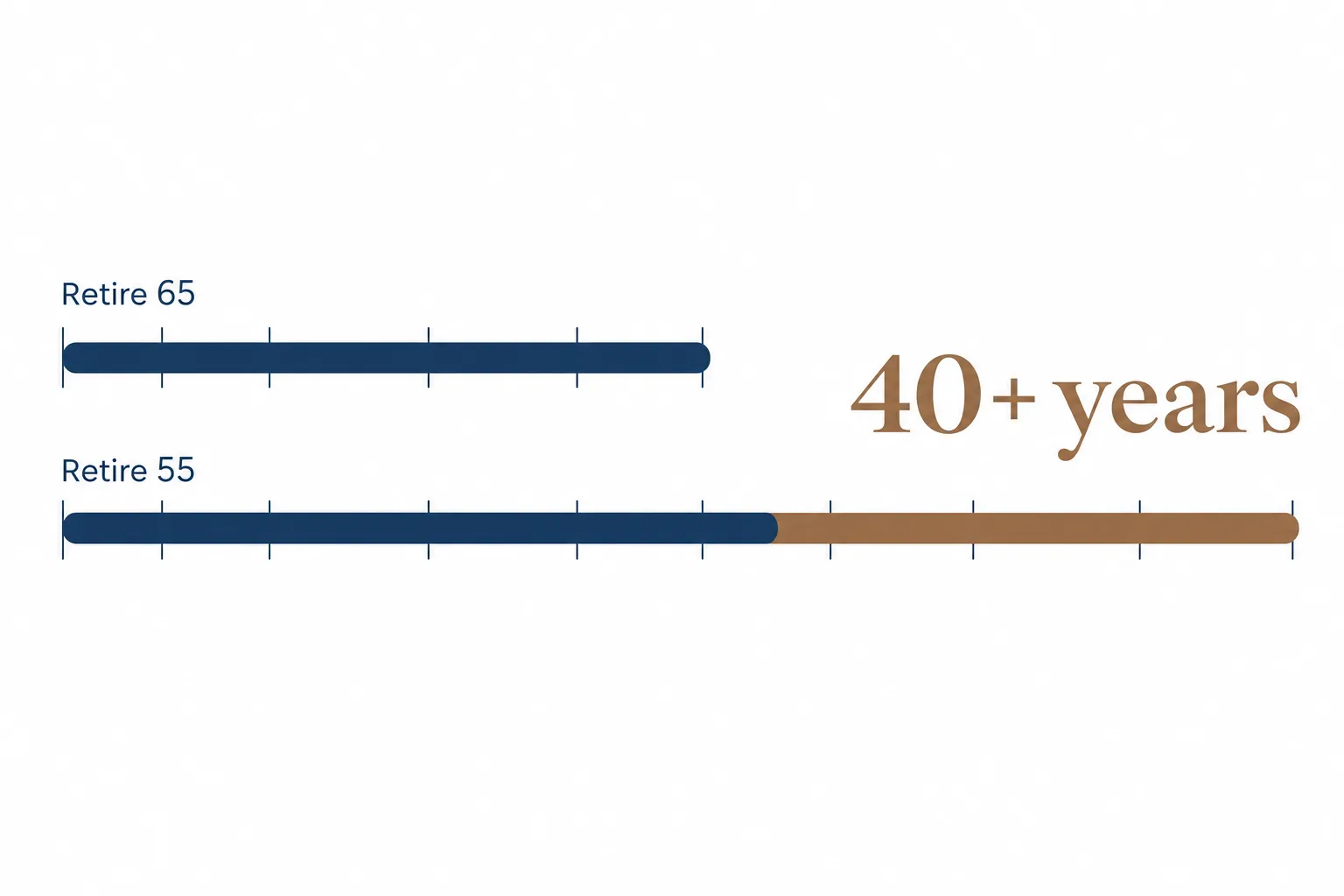
The traditional rule was developed around an approximately 30-year horizon. Someone retiring at 55 may need income for 35, 40, or more years, so the original framework may not directly apply. A longer horizon, different spending pattern, or different asset allocation should be modeled separately.
What the 4% Rule Does Not Include
- Other income. Social Security, pensions, rental income, and deferred comp sit outside the rule. It describes portfolio withdrawals only, and it says nothing about when to claim.
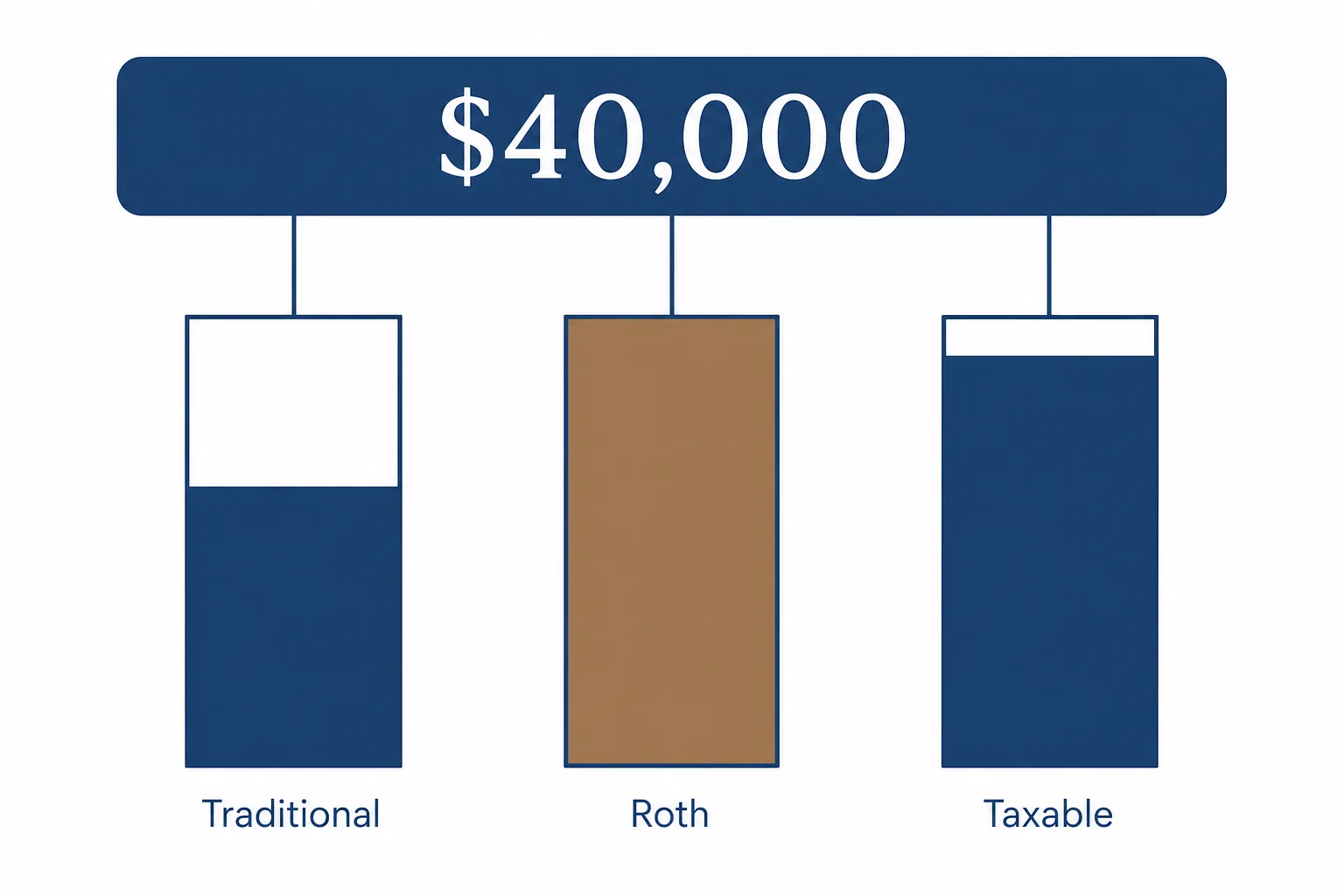
- Taxes. A $40,000 traditional IRA distribution is generally taxable as ordinary income, while a qualified Roth IRA distribution is generally tax-free; a taxable-account withdrawal may include both basis and taxable gains. The same headline number can produce a different spendable amount after tax.
- Fees. Investment and advisory costs reduce the amount available to fund spending.
- Lumpy expenses. Health care, long-term care, gifts, weddings, or a second property may not fit a smooth inflation-adjusted spending line.
- Required minimum distributions. Once RMDs start, the tax code can require a withdrawal larger than 4%.
Does the 4% rule preserve principal?
Not necessarily. It is a depletion model, not a perpetuity model. The success test is binary: did the portfolio avoid hitting zero within 30 years? Ending at $1 and ending at $2 million both count as a pass. That matters if your goal is passing assets to heirs, funding a charitable legacy, or keeping a family business capitalized. If preserving principal is a priority, the withdrawal plan may need a lower rate, additional income, or a different spending approach.
Sequence-of-Returns Risk: Why Early Losses Matter
Poor returns early in retirement can do outsized damage because withdrawals may require selling assets after a decline, leaving fewer assets to participate in a recovery.
Two retirees can earn an identical average return over 30 years and land in completely different places based only on the order in which those returns arrived.
Sequence risk is one of the biggest threats to retirement savings.
Rigidity cuts both ways. Follow the rule strictly through a strong decade, and you may leave a large unspent balance you could have enjoyed or gifted. Follow it through a weak one, and you draw down a shrinking portfolio on schedule. Real retirement spending is not a straight line either: it usually runs high early during the active years, dips in the middle, and rises again with health costs.
Common 4% Rule Mistakes to Avoid
- Recalculating 4% of the new balance each year. That is a different strategy with different, more volatile results.
- Counting illiquid assets in the total. Home equity, a closely held business interest, or private holdings you cannot sell on a Tuesday do not behave like the liquid portfolio the model assumes.
- Applying a 30-year assumption to a retirement that starts at 55. A longer horizon should be modeled separately.
- Ignoring account location. Withdrawals from taxable, tax-deferred, and Roth accounts can produce different after-tax results.
- Forgetting RMD timing. Under current IRS rules, traditional IRA owners generally begin required minimum distributions at age 73; the applicable age can be 75 for certain later birth cohorts.
How the 4% Rule Compares With Flexible Withdrawal Strategies
A 7% withdrawal rate generally relies on more optimistic assumptions and can carry greater depletion risk over a long retirement. An 8% rate requires still higher assumed returns or a more aggressive allocation; neither figure should be presented as generally safe without clearly stated assumptions. Average returns are not sequence-adjusted returns, and inflation still affects purchasing power.
More flexible approaches adjust spending or portfolio withdrawals as conditions change. Guardrail strategies raise or reduce spending within preset bands. A bucket approach holds near-term spending in cash and short-term bonds, which may reduce the need to sell equities during a downturn. A floor-and-upside approach uses income sources intended to cover essential expenses and the portfolio for discretionary spending. Each approach still needs to be tested against personal cash flow.
Why Business Owners Need a More Tailored Withdrawal Plan
A flat 4% assumption may be too narrow when a business sale, multiple account types, tax planning, or legacy goals are part of the picture. Proceeds from a business sale may arrive as a concentrated, taxable event, and a smooth percentage does not show the tax effect around it. For owners preparing for a transition, business succession planning can connect the sale timeline with retirement income, taxes, and legacy goals.
Withdrawal sequencing across taxable, tax-deferred, and Roth accounts changes how much of each dollar a household actually keeps. The years between retirement and RMD age may create a planning opportunity for Roth conversions. Qualified charitable distributions may help fund giving from eligible accounts; review the rules with a tax professional and the IRS guidance on IRA distributions.
Alternative and private-placement investments may have different liquidity and distribution profiles from the public stock-and-bond portfolios used in historical studies. Concentrated equity, deferred compensation, and multiple business entities can also make a single-portfolio framework less representative.
Portfolio construction is one part of the broader investment advisory conversation when withdrawals, liquidity, and risk need to be considered together. This is general education rather than tax or legal advice; the specifics belong in a conversation with your tax professional.
How to Use the 4% Rule in a Retirement Plan
Treat it as a feasibility test before you retire and a periodic reality check on spending, not as the withdrawal policy itself. Morningstar’s late-2025 research estimated a 3.9% starting rate for a retiree seeking consistent inflation-adjusted spending over 30 years under its assumptions and a 90% probability-of-success framework. That estimate is not a universal rate.
A practical next step is a cash-flow analysis built on actual spending, other income, taxes, account structure, and time horizon, then revisited after a major market move, tax-law change, or liquidity event.
4% Rule Retirement Withdrawal FAQs
How long will $500,000 last using the 4% rule?
Does the 4% rule include Social Security?
What is Dave Ramsey’s 8% rule?
Is the 4% rule still valid today?
Does the 4% Rule Work for Early Retirement?
What Is the 25x Rule?
How Do Taxes and RMDs Affect the 4% Rule?
Build a Retirement Withdrawal Plan Around Your Numbers
If you are within a few years of retirement or have recently sold a business, a retirement-income review can connect your spending, taxes, account structure, other income, and time horizon.
Weston Banks works with business owners, retirees, and families in Raleigh through personalized financial planning. Learn more about retirement planning, What We Do, Who We Are, or book a Consultation. A withdrawal percentage is only one input; the goal is a plan that connects income, spending, taxes, investments, and legacy goals.