
For many business owners, the company is more than a source of income. It is the retirement plan, the family safety net, the legacy asset, and the sale they have been counting on for years. So when revenue drops, a buyer backs out, or the business starts to fail before an exit, the concern gets personal fast: what happens to my retirement savings if my business fails before I sell?
That question is not only about whether creditors can touch a 401(k). It is about whether your full retirement plan still works if the business sale you expected never happens. A qualified retirement account may be protected from the company’s creditors, but that protection does not replace lost business value, missed sale proceeds, tax exposure, personal guarantees, or the pressure to maintain your lifestyle after retirement.
Business failure does not automatically mean your 401(k), pension, or IRA disappears. But if your expected sale proceeds were part of your retirement plan, the bigger issue is whether your income, taxes, estate plan, and lifestyle still hold up. This guide explains what may be protected, what may be exposed, and what business owners should review before making rushed decisions.
What Happens to My Retirement Savings if My Business Fails Before I Sell?
If you are asking, “What happens to my retirement savings if my business fails before I sell,” start with this distinction: your business assets and qualified retirement plan assets are usually not the same thing.
A business bank account, accounts receivable, inventory, vehicles, equipment, and company real estate may become part of a creditor dispute if the business fails. But many qualified retirement plan assets are designed to be held apart from the employer’s business assets. The U.S. Department of Labor explains that retirement assets generally should not be at risk if an employer declares bankruptcy because federal law requires plan assets to be kept separate from business assets and held in trust or invested in an insurance contract. The DOL also states that employer creditors cannot make a claim on retirement plan funds.
That protection is important, but it does not solve the whole problem for a business owner. If the sale of the company was supposed to fund retirement, then a protected 401(k) may survive while the larger retirement income plan still breaks down.
A 401(k), profit sharing plan, SEP IRA, SIMPLE IRA, rollover IRA, Roth IRA, or defined benefit plan may each face different rules. A taxable brokerage account, business savings account, or cash reserve may not receive the same protection. And business sale proceeds that never arrive cannot be protected because they do not exist yet.
For owners, the bigger danger is often not that a court takes the 401(k). It is that fear causes the owner to cash it out, use it to cover payroll, pay vendors, keep the doors open, or buy time for a sale that may never close. Once retirement money leaves a protected account, it may lose special protection and may trigger income taxes and penalties.
Before a failed sale forces that kind of decision, a business owner should review the retirement plan, tax exposure, cash flow, estate plan, business debt, insurance, and succession options together. That is where a planning-led approach matters.
Business owners in this position often need more than investment management. A coordinated review with a business succession advisor can help connect personal wealth, company risk, tax exposure, and retirement income before pressure limits the options.
Is a 401k Protected From Bankruptcy When a Business Fails?
For most people, yes, a 401(k) is protected from bankruptcy when the money remains inside a qualified retirement plan. That can apply when an employer goes bankrupt, shuts down, sells, or terminates the plan. A 401(k) is usually held in a trust, not in the employer’s operating account, so a company going out of business does not mean the account balance disappears.
This is why the answer to “can bankruptcy take your 401k” is usually no when the funds remain inside a qualified plan. It is also why “does bankruptcy affect 401k” needs a careful answer. Bankruptcy may affect access, timing, rollover paperwork, plan administration, company stock value, and unpaid contributions, but it generally does not allow the employer’s general creditors to take properly held plan assets.
The IRS says that when an employer files Chapter 7 liquidation bankruptcy, the trustee controls the business assets, liquidates them, closes the business, and terminates the company’s retirement plans. The IRS also explains that the law generally protects retirement plan assets from the bankrupt employer’s creditors by requiring those assets to be kept separate from employer assets and held in trust or invested in insurance.
In plain terms, if your contributions reached the 401(k) plan and you are vested, the money is generally yours. If the plan terminates, the plan administrator should provide instructions on distributions or rollover options.
For business owners, the planning issue is different from the legal issue. The legal issue is whether the 401(k) is protected. The planning issue is whether that 401(k), by itself, can still support the retirement lifestyle you expected after the business sale. That is where many owners need a new retirement income plan, not just a bankruptcy answer.
| Retirement Asset | General Protection if Business Fails | Main Risk for Business Owners |
| 401(k) plan assets already deposited | Usually strong federal protection | Loan default, plan termination, rollover timing, company stock losses |
| Profit sharing plan | Usually protected if properly qualified | Vesting, records, administration delays |
| Defined benefit plan | May be protected by PBGC up to legal limits if covered | Underfunding, funding obligations, benefit limits |
| Traditional IRA or Roth IRA | Protected in bankruptcy up to federal limits, with state-law issues outside bankruptcy | Excess balances, inherited IRA concerns, creditor rules outside bankruptcy |
| Taxable brokerage account | Often not protected as a retirement account | Creditor claims, lawsuits, liquidity needs |
| Business sale proceeds | Not protected until they exist and are planned for | Failed sale, lower valuation, tax exposure |
| Business equity | Not a protected retirement account | Value may collapse if the business fails |
What Happens to 401k if Company Goes Bankrupt or Closes?
If your company closes, the retirement plan usually goes through a transfer, freeze, merger, or plan termination process. In a business sale, the buyer may merge the existing 401(k) plan into its own plan, continue the plan for a period, or require the seller to terminate the plan before closing. In a full shutdown, the plan often terminates.
That is why people search for what happens to 401k if company goes bankrupt, what happens to 401k if company goes out of business, or what happens to my 401k if the company closes. The practical answer is that deposited and vested 401(k) funds usually remain yours, but you may need to act.
A plan termination may allow a direct rollover to an IRA, a rollover to another qualified plan if allowed, or a taxable distribution. A direct rollover often helps avoid current income tax and possible early withdrawal penalties. Cashing out can feel tempting if the business needs money, but that may turn one problem into two: a failed business and a reduced retirement account.
If you own the business, there is another layer. The plan administrator still has duties. Participant notices, final contributions, compliance testing, Form 5500 filings, forfeiture accounts, distribution timing, and recordkeeping may still matter after revenue stops.
This is where Weston Banks’ comprehensive planning angle becomes especially relevant. A business owner does not only need to know where the 401(k) goes. The owner needs to know how the business closure affects retirement income, taxes, personal guarantees, estate planning, and family cash flow. Their work on how selling a business affects retirement planning is a relevant reference for owners who are still close to a potential exit.
Can a Company Take Your 401k?
A company generally cannot take your 401(k) plan assets to pay its creditors, vendors, payroll, leases, or operating bills. It is not legal for a company to treat plan assets like business cash. If employee contributions were withheld from payroll, those amounts must be handled under plan and federal rules.
That said, “can a company take your 401k” is a common fear because business failure often creates confusion. Employees may lose access to HR. Owners may stop receiving regular updates from vendors. A recordkeeper may change. A plan may freeze. A company may terminate the plan. None of that automatically means the money is gone.
If you are an employee, ask for the plan administrator, the latest account balance, the Summary Plan Description, and rollover instructions. If you are the owner, get legal, tax, and plan-administration guidance before you promise timing or distributions to employees.
For business owners, this is also a credibility issue. If employees contributed to a retirement plan, those contributions should not be treated as emergency working capital. Protecting plan integrity protects employees, reduces legal exposure, and helps preserve the owner’s professional reputation even during a difficult wind-down.
If a plan appears abandoned, the Department of Labor has an Abandoned Plan Program that can help wind up certain individual account plans and distribute benefits. In 2024, DOL expanded the program, so Chapter 7 bankruptcy trustees could use it for certain abandoned individual account retirement plans.
Bankruptcy and 401k: What Business Owners Often Miss
Business owners often ask, “Can I lose my 401k?” But a better question is, “What decisions could cause me to lose protection, trigger taxes, or weaken my retirement plan?”
The first risk is a voluntary withdrawal. If you cash out a 401(k) before age 59½, the distribution may be subject to ordinary income tax and a 10% early withdrawal penalty unless an exception applies. Once the money lands in a checking account, it may no longer have the same retirement-account protection. If that cash then goes into a failing company, the owner may lose both the business and the retirement reserve.
The second risk is a 401(k) loan. If the company closes or the plan terminates, an unpaid loan may become taxable if it is not handled properly. That tax bill may arrive at the worst possible time.
The third risk is a personal guarantee. Retirement accounts may be protected, but assets outside retirement accounts may not be. Many owners sign guarantees on leases, equipment, credit lines, or business loans. Those guarantees can affect the household financial picture even when the 401(k) remains safe.
The fourth risk is concentration. Many entrepreneurs have income, net worth, real estate, and retirement expectations tied to the same company. When the business is the main wealth engine, a failed sale can expose how little diversification exists outside the company.
This is where a broader retirement advisor review can help. The question is not only “Is a 401k protected from bankruptcy?” The better question is, “Can my retirement still work if the business does not sell?”

What Happens to Pension if Company Goes Bankrupt?
A pension is different from a 401(k). A 401(k) is a defined contribution plan, where the account balance depends on contributions and investment results. A pension is often a defined benefit plan, where the plan promises a benefit based on a formula.
If you are asking what happens to a pension if the company goes bankrupt, the answer depends on whether the plan is covered by the Pension Benefit Guaranty Corporation, whether the plan terminates, and whether enough assets exist to pay promised benefits. PBGC explains that employer bankruptcy does not automatically end a pension plan. Some employers come out of bankruptcy without terminating the plan. If the plan does terminate and PBGC becomes trustee, PBGC may pay benefits up to legal guarantee limits.
This matters for business owners who sponsor or participate in a defined benefit plan, cash balance plan, or pension arrangement. A defined benefit plan can be valuable for retirement and tax planning, but it also needs proper funding and administration.
The Department of Labor gives a useful distinction: traditional pension plans may receive PBGC protection if a plan terminates because an employer has financial difficulty and cannot fund it, but defined contribution plans such as 401(k) plans are not insured by PBGC.
For high-net-worth business owners, pensions and cash balance plans should be reviewed before a sale, bankruptcy, or wind-down. These plans may be part of a tax mitigation strategy, but they also create responsibilities that need careful timing. Waiting until the doors shut can reduce available options.
What if My Pension Provider Goes Bust?
This question is different from employer bankruptcy. A pension provider, custodian, insurer, recordkeeper, or investment platform may serve the plan, but the employer is usually the plan sponsor. If a provider fails, the plan’s assets do not automatically become provider assets. Custody structure, insurance contracts, SIPC rules, state guaranty associations, and plan documents may all matter.
For a 401(k), the recordkeeper may change. For a pension, an insurance contract or trust may be involved. For an IRA, the custodian may be a bank, brokerage, or trust company. The right answer depends on the type of account and its legal structure.
The practical lesson for business owners is simple: keep clean records before the business is under pressure. Save account statements, plan documents, beneficiary forms, plan administrator contacts, payroll records, and contribution records. During a shutdown, good records can save months of stress.
Selling 401k Plans, Plan Termination, and a Business Sale
When people search for selling 401k plans or selling 401k, they may mean several different things. Some mean, “Can I cash out my 401(k) if my company is sold?” Others mean, “What happens to the company retirement plan when the business sells?” Those are not the same question.
In a stock sale, the buyer may acquire the company with the retirement plan still attached unless the deal says otherwise. In an asset sale, the buyer may purchase selected assets and leave the old legal entity responsible for the retirement plan. Deal terms matter.
A buyer may ask the seller to terminate the 401(k) plan before closing. If that happens, affected participants generally become 100 vested in accrued benefits, and distributions or rollovers follow plan rules. That can be manageable, but it needs coordination with the plan administrator, attorney, CPA, and financial advisor.
If a business sale collapses, the owner may still have to maintain, freeze, or terminate the plan, handle final contributions, address employee questions, and decide what happens to owner and employee account balances.
A failed sale does not remove the need for planning. It makes planning more urgent. If the business was expected to create retirement liquidity, the owner must revisit valuation, tax exposure, investment income, risk management, and household cash flow.
| Business Event | Retirement Plan Impact | Owner Planning Priority |
| Stock sale | Plan may transfer with company unless deal requires change | Review plan liabilities before signing |
| Asset sale | Seller may keep responsibility for plan termination | Coordinate plan termination and rollover timing |
| Failed sale | Plan may continue, freeze, or terminate | Rebuild retirement income assumptions |
| Chapter 7 liquidation | Trustee may close business and terminate plans | Contact plan administrator and legal counsel |
| Chapter 11 reorganization | Plan may continue or terminate with court approval | Review funding, cash flow, and employee obligations |
| Company closure without buyer | Plan likely needs formal wind-down | Preserve records and direct rollovers where possible |
If a sale is still possible, review the company’s value before relying on old assumptions. Weston Banks’ guidance on finding out what a business is worth before selling can help frame that conversation.
Bankruptcy Retirement Accounts: Which Savings Are Most at Risk?
The phrase bankruptcy retirement accounts covers several account types, and the protection is not equal.
ERISA-qualified plans, such as many 401(k), 403(b), pension, and profit-sharing plans, often receive strong protection in bankruptcy. Traditional IRAs and Roth IRAs also receive federal bankruptcy protection, but the exemption has a limit that adjusts over time.
Federal Register updates for bankruptcy dollar amounts took effect April 1, 2025, and the aggregate bankruptcy exemption for IRAs and Roth IRAs is commonly listed at $1,711,975 for the 2025–2028 period.
That does not mean every retirement-related asset has the same protection. State law may matter outside bankruptcy. Inherited IRAs may face different treatment. IRS levies are a separate issue. A regular brokerage account meant for retirement is not the same as a qualified retirement account.
For high-net-worth individuals, this distinction is especially important. Larger portfolios often include retirement accounts, taxable accounts, business interests, real estate, insurance products, and sometimes alternative investments or private placement opportunities. Each bucket can have different tax, liquidity, and creditor-risk treatment.
Alternative investments and private placements are not a bankruptcy rescue tool. They are also not suitable for every investor. But for qualified clients, they may be part of broader planning around diversification, income, tax exposure, and long-term portfolio structure. A comprehensive investment advisor can help review which assets are protected, which are exposed, and which may need a different role in the retirement plan.
Does Bankruptcy Take Your 401k if You File Personally?
If the business fails and the owner files personal bankruptcy, the answer is still usually no for qualified 401(k) assets that remain inside the plan. A personal bankruptcy court generally treats many retirement accounts as protected assets, though retirement income may affect means testing or Chapter 13 repayment ability.
The problem often starts before filing. If the owner drains the account to pay business debts, the money may lose its protected status and create taxable income. That withdrawal may also create a 10% early distribution penalty if the owner is under age 59½ and no exception applies.
So, does bankruptcy take your 401k? Usually not while it remains in a protected qualified plan. Can bankruptcy take your 401k after you cash it out and deposit it into a regular account? That may be a different question.
That is why owners should not use retirement funds as emergency business capital without legal, tax, and financial guidance. Pulling money out to buy another month can cost far more than the month is worth.
What Happens to Employees When a Company Files Bankruptcy?
Employees often worry about wages, health benefits, severance, retirement contributions, and job security when a company files bankruptcy. If the company reorganizes, jobs and benefits may continue with changes. If it liquidates, the company may close, employees may lose jobs, and the retirement plan may terminate.
Employee rights after bankruptcy depend on the bankruptcy chapter, state wage law, federal benefits law, plan documents, and court decisions. For retirement plans, employees should confirm that payroll deductions reached the plan trust and should save statements.
For the owner, this section comes back to stewardship. A difficult business outcome does not remove the responsibility to handle employee retirement contributions properly. Owners should avoid vague promises and work with the plan administrator, attorney, and CPA to communicate clearly.
If employees ask what happens to employees when a company goes bankrupt, the most responsible answer is that wages, benefits, and retirement plans follow different rules. They should receive plan notices and may need to contact the plan administrator directly.
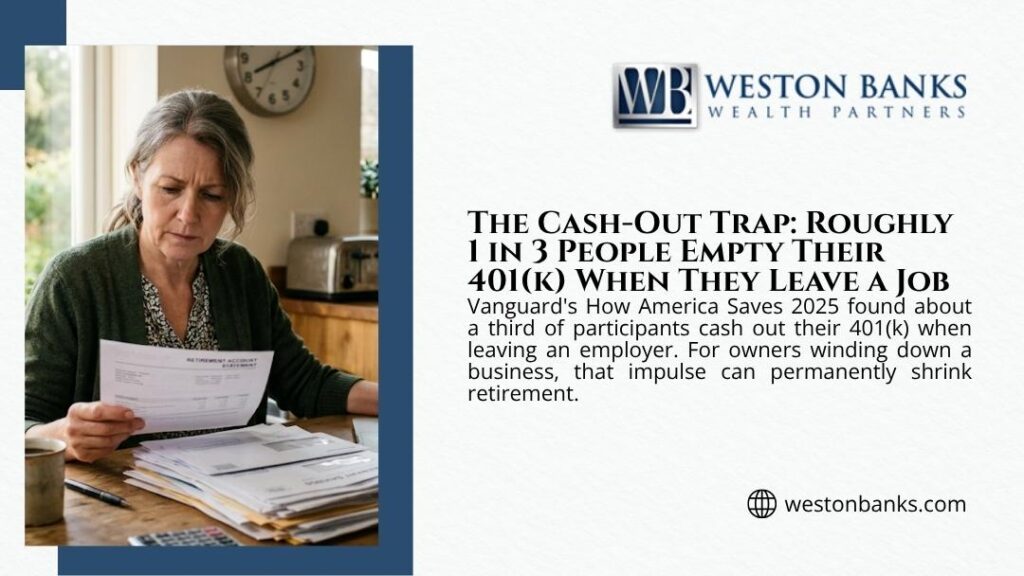
Can I Cash Out My 401k if My Company Is Sold?
You may be able to cash out a 401(k) if the plan terminates or if the plan allows distribution after separation from service. But “can I” and “should I” are not the same question.
A cash-out can trigger income taxes. If you are under age 59½, it may also trigger a 10% early withdrawal penalty unless an exception applies. A direct rollover to an IRA or another eligible retirement plan can often preserve tax deferral and keep the money in a retirement structure.
For a business owner, cashing out retirement funds after a failed sale may feel like a way to regain control. In many cases, it is actually a signal that the broader retirement plan needs to be rebuilt. The owner may need to replace expected sale proceeds with portfolio income, delayed retirement, reduced spending, new business income, insurance planning, or a different succession path.
Before selling, closing, or filing bankruptcy, owners should review the tax side carefully. Weston Banks’ insights into the tax implications of selling a small business before retirement align with this part of the planning process.
Tax Mitigation After a Failed Business Sale
Tax mitigation is not only for profitable exits. It also matters when a business sale fails, because owners may face tax issues from retirement withdrawals, debt cancellation, asset sales, payroll tax problems, 401(k) loan defaults, capital gains on partial sales, or the sale of business real estate.
A business owner may need to compare the tax result of an asset sale versus a stock sale. They may need to decide whether to preserve cash, contribute to a retirement plan, terminate a plan, or roll assets into an IRA. They may need to assess whether business losses can offset other income, whether estimated tax payments should change, or whether charitable giving still fits the plan.
This is one of the clearest Weston Banks angles. Their value is not only investment selection. It is comprehensive planning that connects retirement income, tax exposure, estate planning, risk management, and business transition decisions.
Tax planning should not happen after the damage is already done. For owners near retirement, it should be part of the same conversation as business valuation, succession timing, and household cash flow.
What Business Owners Should Do Before a Sale Fails
If a sale is weak, a buyer is slow, cash flow has changed, or debt has become harder to manage, the owner needs a clear view of the full picture.
First, separate business assets from retirement assets. Then confirm that all employee and employer retirement contributions were deposited. Review 401(k) loans, company stock exposure, plan documents, vesting rules, and plan termination requirements. Next, review personal guarantees and debts that may follow you outside the business.
Then ask the hard retirement question: if the business does not sell, where does retirement income come from?
That question should include lifestyle. Can the household maintain its current standard of living? Does retirement need to be delayed? Is there enough investment income? Are insurance policies still appropriate? Does the estate plan still reflect reality? Should business succession plans change?
A firm that provides retirement planning and wealth management services can help model those scenarios. The value is not only in managing investments. It is in helping the owner make fewer rushed decisions when the business and personal plan start to overlap.
| Question to Ask | Why It Matters |
| Are all retirement contributions deposited? | Missing deposits may create legal and employee-benefit issues |
| Is the plan qualified and current? | Protection depends on proper structure and administration |
| Are there 401(k) loans? | Loan default may create taxable income |
| Is company stock inside the plan? | Business failure may reduce account value |
| Are there personal guarantees? | Retirement assets may be protected while other assets remain exposed |
| Is a rollover needed? | A direct rollover may preserve tax deferral |
| Was the business sale the main retirement plan? | A failed sale may require a new income strategy |
| Is the estate plan current? | Beneficiary and legacy goals may need review after business stress |
How to Protect Retirement Savings if the Business Is Already in Trouble
If the business is already under pressure, the best move is to slow down major retirement decisions. That may feel strange when bills are due, but rushed withdrawals can be hard to undo.
Do not cash out a retirement account before speaking with a bankruptcy attorney, CPA, and financial advisor. Do not assume a buyer will save the company. Do not ignore plan administration duties. Do not delay employee retirement contributions. Do not assume a business valuation from two years ago still applies. Do not treat company stock as diversified wealth.
Instead, build a practical survival map. Review household cash flow. Estimate retirement income without a business sale. Compare an asset sale and a stock sale. Review tax mitigation strategies. Recheck insurance coverage. Review estate planning documents. Identify which assets are protected and which are exposed.
For business owners and high-net-worth individuals, this is where a small, high-touch advisory relationship can matter. The goal is not to create a stack of generic reports. The goal is to help the owner understand the next right decision before pressure narrows the options.
Weston Banks works with clients who often need more than basic portfolio advice. Their personal financial advisor speaks to that broader need for planning around life, assets, and long-term goals.
Why This Question Matters More for Business Owners Than Employees
Employees usually build retirement savings from wages. Business owners often build retirement expectations from company value. That makes failure before a sale especially painful.
An employee may ask, “What happens to my 401k if the company closes?” A business owner asks that too, but with more at stake. The owner may also need to know whether the company can still sell, whether personal guarantees will come due, whether the retirement plan has been administered properly, whether employees are protected, whether tax obligations remain, and whether retirement must be delayed.
That is why what happens to my retirement savings if my business fails before I sell is not just a 401(k) question. It is a succession question, a tax question, an estate question, a risk management question, and a retirement lifestyle question.
A business that fails before sale can still leave the owner with protected retirement accounts. But it may also erase the expected sale proceeds. If the business was the main retirement asset, the plan must be rebuilt around what remains, not what the owner hoped the company would bring.
For many owners, that rebuild starts with a realistic income plan. Weston Banks discusses how to not run out of money in retirement, reflecting a core concern: retirement security should not depend on hope alone.
A Raleigh Planning Lens for Owners Near Retirement
For business owners in Raleigh and the broader North Carolina market, relationships often shape referrals, sale conversations, succession choices, and professional advice. A future buyer may be a local contact. A banker, CPA, attorney, or successor may come through the same network. That can be helpful, but it can also create blind spots.
A familiar buyer can still walk away. A handshake valuation may not survive due diligence. A tax strategy may not work if it starts after the letter of intent. A retirement plan may not be ready for termination when the owner needs a clean closing.
Many business owners do not want a remote, transactional answer. They want a trusted planning relationship with people who understand how business, family, retirement, and community overlap.
If the sale is still years away, there may be time to increase business value, reduce owner dependence, diversify personal assets, and protect retirement accounts. If the company is already stressed, the goal shifts to preservation, clarity, and fewer rushed moves.
Weston Banks’ perspective on when to start planning to sell a business highlights timing from the sale side, while the retirement side requires the same early attention.
The Bottom Line for Retirement Savings After Business Failure
So, what happens to my retirement savings if my business fails before I sell? In most cases, qualified retirement savings such as a 401(k), profit-sharing plan, or covered pension may remain protected from the company’s creditors if the money is properly held in the plan. If a plan terminates, participants may become 100 vested in accrued benefits and may need to roll funds into another retirement account.
But that does not mean the owner is protected from every loss. Business equity may disappear. Sale proceeds may never arrive. Personal guarantees may survive. Taxes and penalties may apply if retirement funds are withdrawn too soon. Pension benefits may be subject to PBGC limits. IRAs may have different rules. Taxable accounts may not receive the same protection.
The smartest move is to avoid treating a retirement account like emergency business capital until you understand the tax, legal, and retirement-income consequences. Once money leaves the retirement plan, the rules can change quickly.
Before a failed sale forces rushed financial decisions, business owners should review retirement accounts, tax exposure, personal guarantees, insurance, estate planning, and succession options with a coordinated advisory team. Weston Banks Wealth Partners works with Raleigh-area business owners and high-net-worth individuals who want clear, long-term financial guidance before major decisions affect retirement.
If your business sale feels uncertain, your retirement plan should not be left to chance. You can start a conversation with Weston Banks to review where your plan stands and what may need attention before the next move.
This article is for educational purposes only and should not be treated as legal, tax, or individualized investment advice. Business owners should consult qualified legal, tax, and financial professionals before taking action.