
Consider two hypothetical retirees. Each starts with the same portfolio balance, takes the same withdrawals, and experiences the same three annual returns, but in a different order. The retiree who faces losses first may end with less money because withdrawals during the downturn leave fewer shares to participate in a later recovery. This is sequence-of-returns risk.
In short, what is sequence of returns risk and why does it matter? It is the risk that the order of investment returns, combined with contributions or withdrawals, changes how long a portfolio can support its intended purpose. The issue is usually most important around retirement, when withdrawals begin, and the ability to replace a market loss with new earnings may be reduced.
Business owners can face an additional planning layer when a concentrated, illiquid business asset and a retirement portfolio are exposed to the same economic cycle. The rest of this article explains the mechanism, the years when sensitivity is often highest, and the planning levers a household can evaluate.
What Is Sequence of Returns Risk in Retirement?
Sequence of returns risk is the risk that the order of your investment returns works against you because you are withdrawing money while markets are down.
Three terms worth defining, since they get used loosely:
- Average annual return is the arithmetic average of yearly results. Compound return reflects how those results interact over time; when returns vary, compound annual growth is generally no higher than the arithmetic average.
- Withdrawal rate is the percentage of the portfolio you take out in a year, usually stated against the starting balance.
- Drawdown is a peak-to-trough decline in value.
During accumulation, ongoing contributions may soften the effect of a downturn because they buy more shares at lower prices. During the retirement withdrawal phase, also called decumulation, the cash-flow pattern can work in the opposite direction. Some educators describe this as reverse dollar-cost averaging: shares are sold to fund spending, so a decline can require more shares to be sold.
Market risk is the risk that values fall. A portfolio can experience the same overall return over a period but produce different outcomes when withdrawals occur in a different order.
Sequence risk is the risk that returns arrive at an unfavorable time relative to your cash flow.
With the same return set and no contributions or withdrawals, the ending value is the same regardless of order, before fees and taxes. Once cash flows enter the picture, return order can change the outcome. During accumulation, continued contributions may soften a downturn; during retirement, withdrawals can force sales while prices are down.
Is sequence-of-returns risk real? Yes. It is a mathematical effect of return order interacting with cash flows, not a forecast of what markets will do. MIT Sloan explains how adverse returns and withdrawals can compound the challenge during retirement distributions.
Why Early Retirement Losses Can Have a Lasting Impact
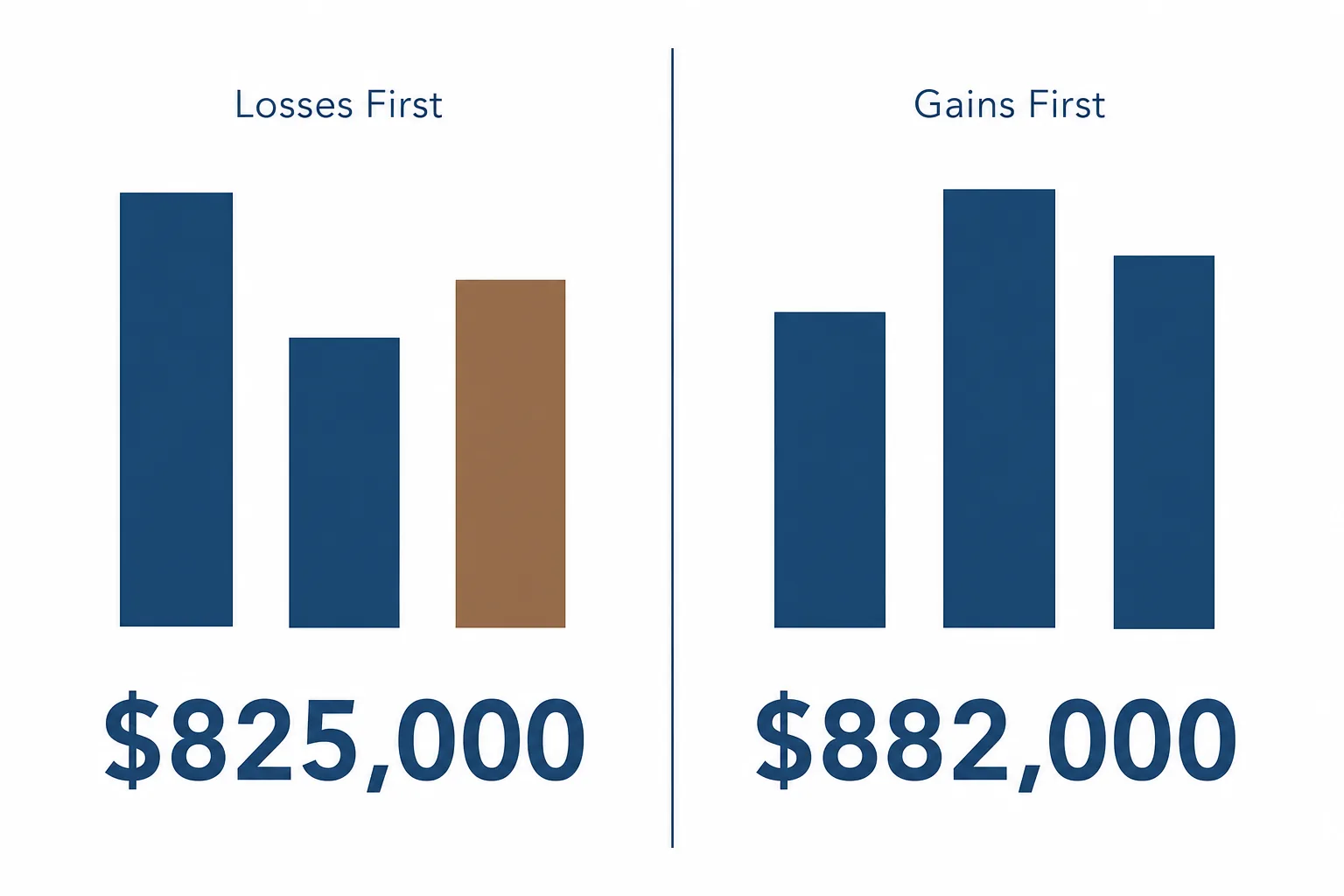
When you withdraw a fixed dollar amount after a portfolio decline, you may need to sell more shares to raise the same cash. Those shares no longer participate in a later recovery, leaving less capital to compound.
Here is the same set of three returns in two different orders. The assumptions are deliberately simple so the arithmetic can be checked.
Assumptions: $1,000,000 starting balance, $50,000 withdrawn at the end of each year, returns applied before withdrawals, and no taxes, fees, inflation, or additional cash flows.
| Year | Losses first: -20%, -10%, +40% | Gains first: +40%, -10%, -20% |
|---|---|---|
| 1 | $750,000 | $1,350,000 |
| 2 | $625,000 | $1,165,000 |
| 3 | $825,000 | $882,000 |
The return set is identical, but the order creates a $57,000 difference after three years. Without withdrawals, both sequences end at $1,008,000 before fees and taxes. This is an illustration of the mechanism, not a projection or an expected result.
Sequence of return risk is the fact that a string of bad returns early in a retirement can hurt the chance of the portfolio surviving more then if they are later.Read on Reddit ↗
A percentage recovery also does not necessarily restore a withdrawing retiree to the same position as an investor who is not taking money out. The market can return to a previous high while the portfolio remains smaller because shares were sold during the decline.
A first-year decline can also change behavior: a household may cut spending, abandon its allocation, or move to cash. A written plan can define possible responses while markets are calm, before a market decline turns into an unplanned allocation or spending decision.
How Long Does Sequence-of-Returns Risk Last?
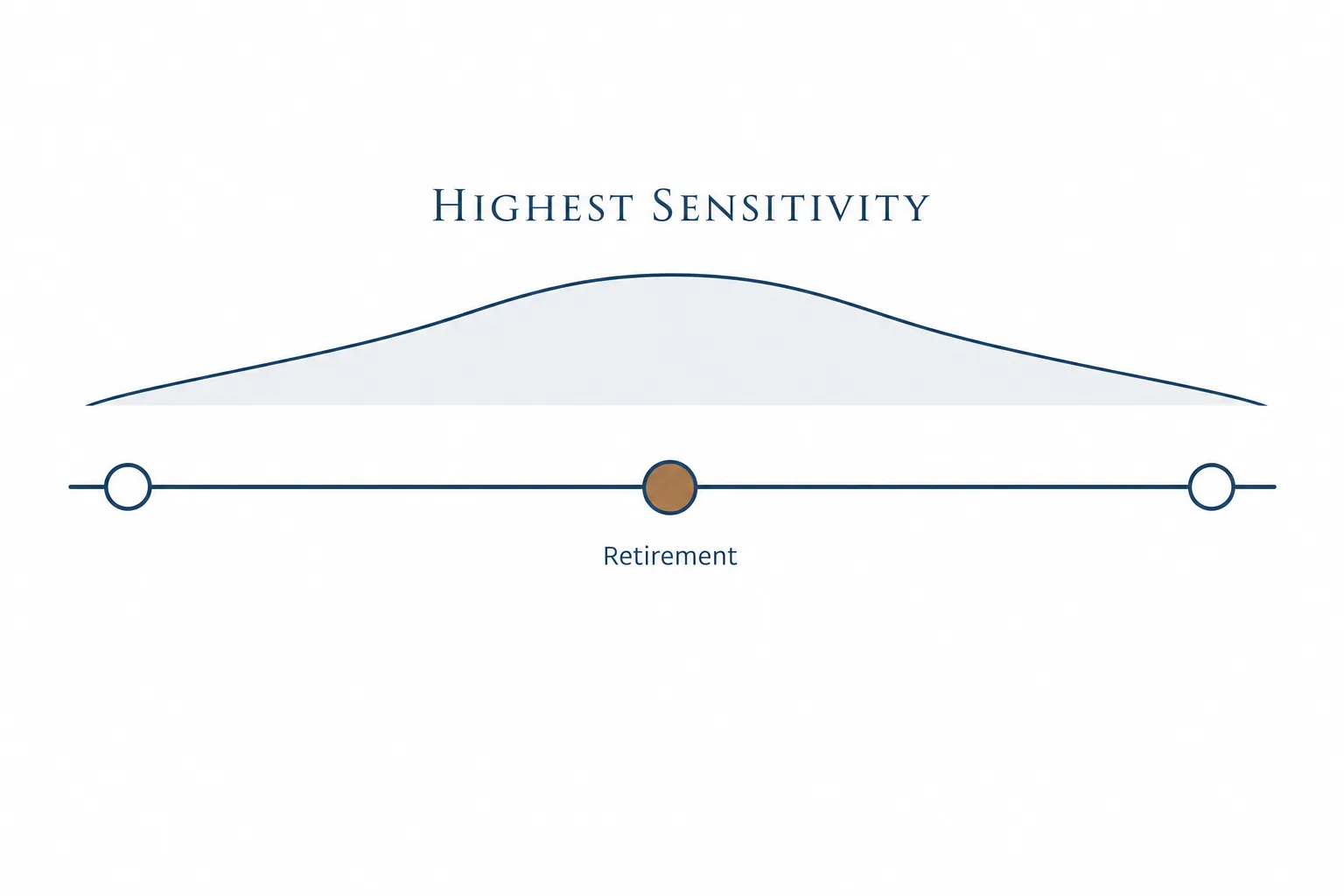
There is no universal cutoff. Sequence-of-returns risk is often most sensitive from the years just before retirement through the first several years of withdrawals. It can remain relevant later when the withdrawal rate is high, the investment horizon is long, spending changes, or other income does not cover enough of the budget.
The early window matters because the portfolio is often near a lifetime peak while the withdrawal stream has a long runway. A loss that occurs early can therefore affect more future spending years than a similar loss near the end of retirement.
Early retirement does not automatically make markets more dangerous. It can make the household more exposed to the interaction between market returns and withdrawals because earned income may no longer be available to replenish the portfolio.
As the remaining horizon shortens and spending patterns change, sensitivity often declines rather than switching off at a specific year. Our guide to other retirement risks explains how market volatility and behavior can affect a plan. For a broader look at retirement income strategy, see how withdrawal planning, Social Security, and portfolio calibration fit together.
How Business Owners Face Sequence Risk Around a Company Sale
For an owner, retirement assets may sit alongside an illiquid, concentrated business interest. Those assets can respond differently to markets, but they may also be affected by the same economic conditions.
A downturn can put several pressures in the same window: the business valuation may weaken, buyers or acquisition financing may become less available, and investment accounts may also be down. That does not make every sale-timing decision a sequence-of-returns issue, but it does make the sale date, retirement date, and post-sale investment plan important to coordinate.
A liquidity event can also create a large, unusually complex tax year. Sale proceeds then have to be deployed into a portfolio that may need to support withdrawals, often while the owner is managing the transition itself. Business succession planning and capital-gains planning can be evaluated alongside the post-sale income plan.
If an owner is still deciding when to begin, planning before a business sale can create more time to coordinate deal structure, tax questions, investment deployment, and retirement income.
This article is general education, not personalized tax or legal advice; the specifics belong with the owner’s qualified advisors.
Related readingHow Do I Avoid Lifestyle Deflation After a Business SaleRead the guide →Can You Eliminate Sequence-of-Returns Risk?
You generally cannot eliminate sequence-of-returns risk while relying on market assets for income, because you cannot control the order of future returns. You can manage exposure through withdrawal decisions, liquidity, asset allocation, and the timing of other income sources. Holding only cash may reduce market volatility, but it introduces inflation and longevity trade-offs.
The planning variables include how much you withdraw, which assets you sell, how much is held in stable investments, how spending can change, and when each income source begins. Moving entirely to cash is not the only alternative to accepting market volatility; it trades one set of risks for another.
The strategies below are planning levers. The appropriate mix depends on household cash flow, essential and discretionary spending, taxes, time horizon, liquidity needs, and risk tolerance.
How Other Income Sources Change Sequence Risk
Sequence risk is partly a cash-flow problem. Social Security, pensions, part-time work, consulting, or other income may reduce how much the portfolio must provide each month. That can reduce forced sales during a downturn, but it does not remove market, inflation, longevity, or tax risk. Modeling essential and discretionary spending separately shows which expenses may be adjusted if returns are poor.
It seems like the biggest risk to a successful FIRE (or even just R) is early sequence of returns risk: having a bad string of market years early in your retirement.Read on Reddit ↗
Seven Ways to Manage Sequence-of-Returns Risk in Retirement
1. A cash reserve you can actually spend from
Some retirement plans reserve one to three years of expected portfolio-funded spending in cash or short-duration holdings. The right amount depends on essential expenses, other income, tax needs, and tolerance for cash drag. The goal is to reduce the chance of selling volatile assets for near-term spending, not to guarantee a recovery.
2. Flexible spending and withdrawal guardrails
Temporary adjustments can reduce the amount withdrawn during a difficult market period. Skipping an inflation increase or deferring a discretionary purchase may reduce the number of shares sold at depressed prices. Guardrails formalize this approach with pre-agreed rules for trimming or raising withdrawals when the withdrawal rate moves outside a chosen range.
3. A stable income floor for baseline expenses
Covering non-negotiable costs, such as housing, insurance, food, and healthcare, with more predictable income can limit the amount of market-dependent spending. Social Security, pensions, bonds, defined-maturity holdings, or other income arrangements have different trade-offs involving inflation, liquidity, interest rates, taxes, and flexibility. For official claiming-age context, review the Social Security Administration’s retirement guidance.
4. Which account you withdraw from, and in what order
The order in which you draw from taxable, tax-deferred, and Roth accounts can affect taxes and the amount you must sell to meet the same after-tax spending need. Required minimum distributions (RMDs) may also affect the plan. Review withdrawal sequencing, loss harvesting, and any Roth-conversion decision with a qualified tax professional; the IRS RMD guidance explains the general rules, while individual application depends on the account and taxpayer.
5. Allocation glidepath through the transition
A glidepath or “bond tent” may reduce volatility around the retirement transition, but the appropriate allocation depends on time horizon, spending, risk tolerance, and other income. Rebalancing can restore the portfolio’s intended weights; it does not prevent losses. Custom investment strategy should be evaluated in the context of the household’s cash flow and liquidity needs.
6. Return sources that do not track public markets
Some investors may consider alternatives or private placements, but these investments can add illiquidity, valuation uncertainty, fees, lockups, complexity, and loss risk. They should be evaluated only when they fit the investor’s objectives, liquidity needs, risk tolerance, and applicable suitability requirements. They are not a universal solution to sequence-of-returns risk.
7. Timing decisions you still control
Retirement-date flexibility, phased retirement or consulting income, and Social Security claiming timing can shift when and how much you draw. For owners, earn-outs, staged sales, and deferred proceeds may also affect when market exposure begins. Working longer can add to the balance and shorten the withdrawal horizon, but the value of that choice depends on health, work, cash flow, taxes, and personal priorities. A retirement-income plan can model how these levers change the portfolio’s required withdrawals.
Does Buffett’s 90/10 Rule Apply to Retirees?
Buffett’s 2013 Berkshire Hathaway shareholder letter described a specific estate-trust instruction: 10% of the cash in short-term government bonds and 90% in a very low-cost S&P 500 index fund. That instruction addressed a particular estate-planning context; it is not a universal retirement allocation.
It is a sensible answer to that specific problem: a large pool of capital with modest spending relative to its size can be positioned to tolerate market declines because the trustee may not need to sell at the bottom.
For a retiree drawing meaningful income, the ratio may leave a smaller stable sleeve than the plan requires. Whether 10% covers one year or several depends on withdrawals, other income, taxes, liquidity needs, and portfolio design.
The transferable lesson is simplicity, low cost, and a deliberate stable sleeve sized to actual spending rather than to a famous ratio.
How to Stress-Test a Retirement Plan for a Bad Return Sequence
A calculator can illustrate the mechanism, but it cannot test your plan unless it includes your spending, account types, taxes, other income, time horizon, and any business-sale proceeds. A smooth average-return line can hide the effect of poor early returns.
A simple sequence-risk comparison holds the starting balance, return set, withdrawal amount and timing, inflation, fees, taxes, and other cash flows constant. It then reorders the returns and compares ending balances, funded years, and the amount of spending that would need to change.
Three questions worth answering before the transition year:
1. How many years of portfolio-funded spending are protected from a forced equity sale? 2. What happens to the plan if the first three years of retirement are negative? 3. Which lever gets pulled first, and who decides?
Confidence grows when a household has already seen how its plan responds to an unfavorable sequence, not when it relies on a single return assumption.
Sequence-of-Returns Risk FAQs
Frequently asked questions
What is sequence of returns risk and why does it matter?
How long does sequence-of-returns risk last?
Is sequence-of-returns risk the same as market risk?
How do you calculate sequence-of-returns risk?
Does sequence-of-returns risk affect a 401(k), IRA, or Roth account?
Does this affect people who are still working and saving?
Do Social Security or pension income eliminate sequence risk?
Do I still face this risk if I only spend dividends and interest?
How far ahead of selling a business should I start planning?
Ready to Stress-Test Your Retirement Income Plan?
If you are within a few years of retiring or selling your business, the next step is to test the cash-flow and timing decisions you can still control.
We start with an introductory meeting to understand your situation and introduce our team. From there, a full financial analysis and written financial plan can review your current accounts, cash flow, allocation, and retirement outlook, and identify where the plan may be exposed to an unfavorable early sequence. The scope and any applicable fees should be confirmed before you engage.
Book a consultation with Weston Banks or call 919-783-8500 to start the conversation. If you are still getting to know the firm, start with What We Do, Who We Are, or the Education hub.
Weston Banks works with business owners, entrepreneurs, families, retirees, and professionals in Raleigh and across North Carolina. The goal is clarity: a retirement income plan that shows what can change, what is protected, and which decisions matter next.
This article is educational and general in nature. It is not personalized investment, tax, or legal advice, and it does not guarantee any particular outcome. Investing involves risk, including possible loss of principal. Please consult qualified professionals regarding your specific situation.